

There is a moment, somewhere around day three, when you realise that Lanserhof Sylt is not a spa. You are sitting in a glass-walled restaurant overlooking the dunes, chewing a single slice of spelt bread thirty times because a doctor has asked you to, drinking nothing because drinking with meals is not permitted, and it occurs to you that you have come to one of the most expensive wellness addresses in Europe in order to eat less than you ever have in your life. This is the paradox at the heart of the place, and it is also the reason it has a claim few rivals can match: of all the beautiful retreats now competing for the exhausted and the affluent, Lanserhof Sylt may be the most serious.
The question in the title deserves an honest answer rather than a brochure one, so it is worth being clear from the start about what “serious” means here. It does not mean joyless, though the uninitiated may find the first days austere. It means that the wellness is the point, the architecture serves the medicine rather than the other way round, and the experience is built to produce measurable change rather than a pleasant weekend. Whether that is what you want is the real question — and the answer says as much about you as it does about the resort.
The setting: an island built for deceleration
Sylt is Germany’s northernmost island, a thin spit of dunes, heath and forty kilometres of beach reaching up toward Denmark, connected to the mainland only by the eleven-kilometre Hindenburg railway causeway across the Wadden Sea. The island has long been the discreet summer retreat of wealthy Germans — it is sometimes called the Hamptons of Germany, and the comparison holds for the property prices as much as the social register. Crucially for a health resort, Sylt is also prized for its bracing marine climate, the clean Atlantic air thought to soothe respiratory and allergic conditions, and a quality of light and emptiness that does a surprising amount of the restorative work on its own.
Lanserhof sits at the island’s northern tip, in the town of List, on a slight rise overlooking the Wadden Sea — itself a UNESCO World Heritage site of shifting tidal flats. You reach it by flying into Sylt’s small airport, which connects to major German cities, or by the more romantic route of putting the car on the train across the dam. Either way, the journey has the effect of a decompression chamber. By the time you arrive, the mainland and its noise already feel a long way off, which is precisely the intention.
The architecture: quiet luxury made literal
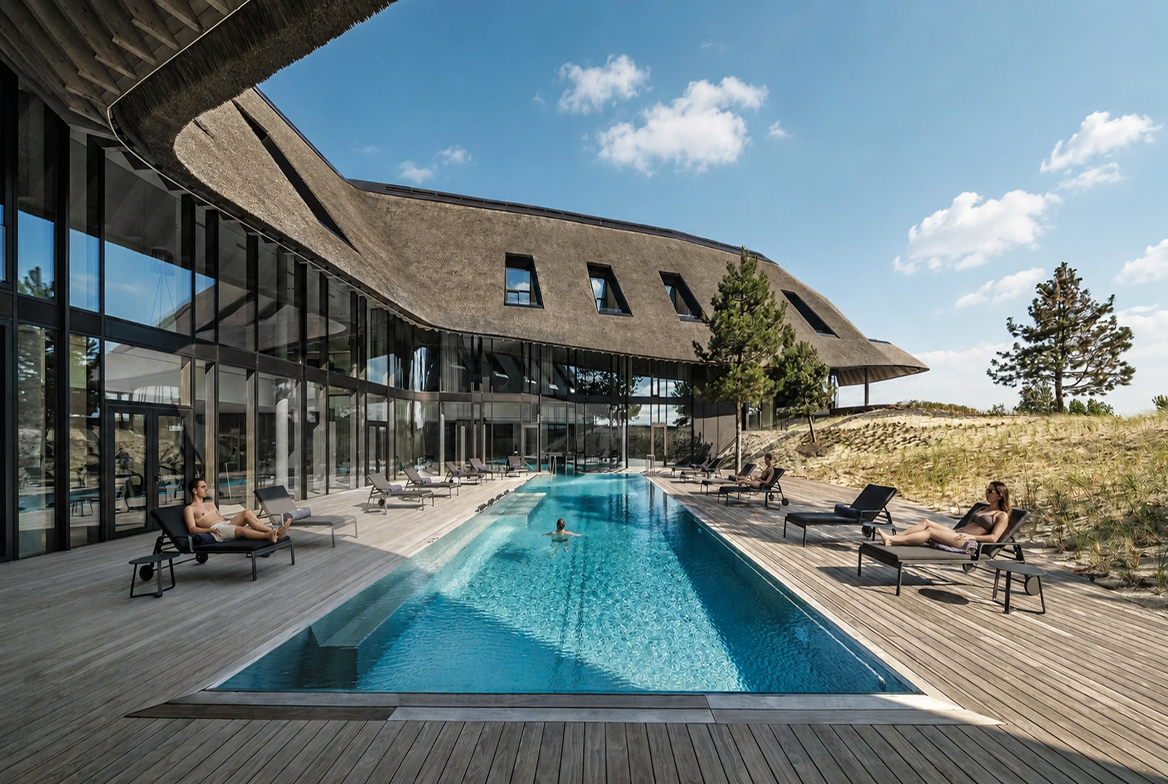
If quiet luxury has a defining building, this might be it. Designed by the German architect Christoph Ingenhoven, who has worked with the Lanserhof group across its properties, the resort is a long, sinuous form that appears to grow out of the dunes. It is topped by what is reckoned to be Europe’s largest thatched roof — roughly 7,100 square metres of reed — a nod to the traditional Frisian houses of the island, here blown up to monumental scale. The thatch seems to float, because beneath it runs a continuous curved glass façade; Ingenhoven cut terraces directly into the roof so that even the rooms tucked under the eaves are filled with light and open to the sea, solving the old problem of thatched houses being dark inside.
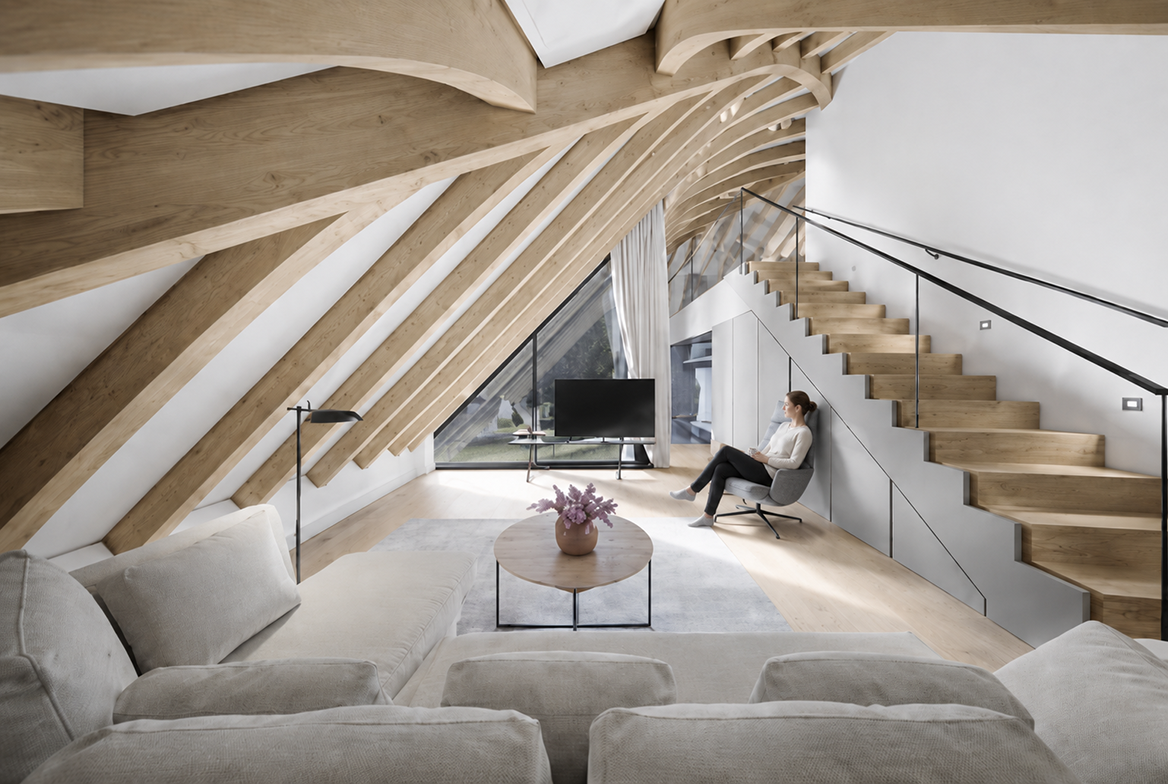
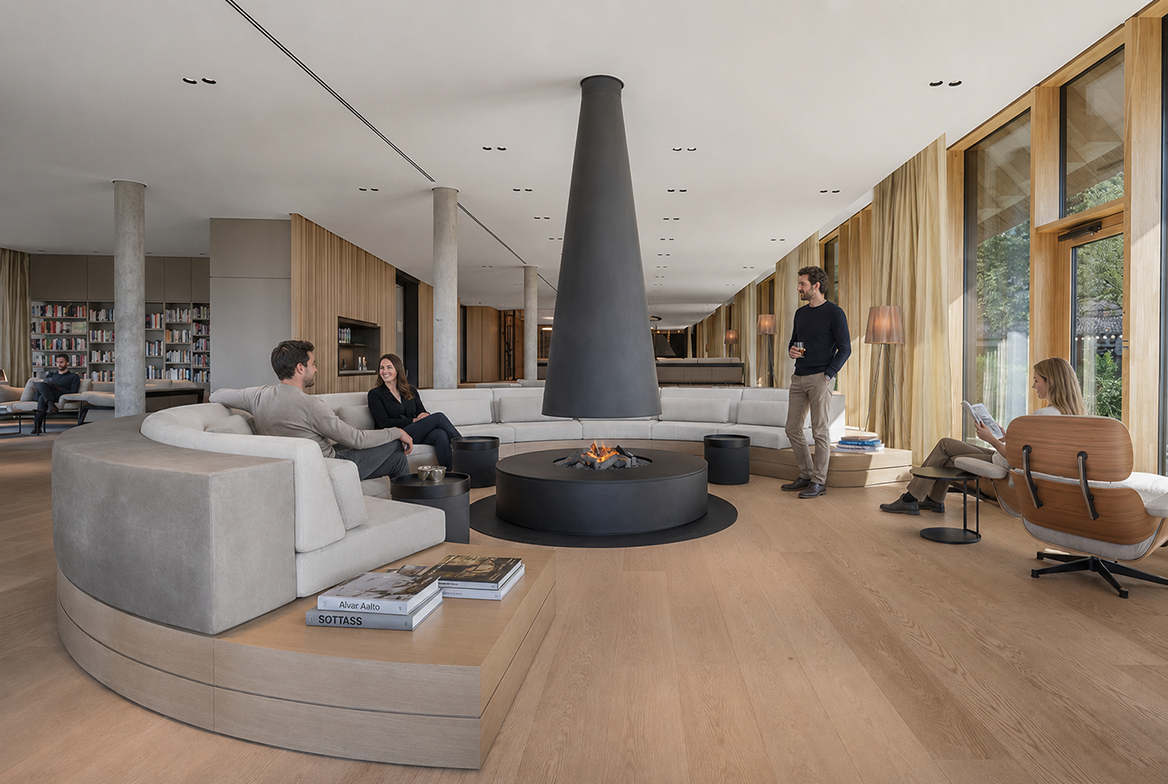
Everything about the interior is calibrated for calm. A five-storey staircase of steel and oak forms the central atrium. The rooms — there are fewer than seventy across the resort, which keeps it intimate — are lined with limed oak floors and slatted timber, dressed in oatmeal and warm grey, and furnished with the quiet good taste of Cassina, Vitra and Knoll. There is no gilt, no spectacle, no lobby theatre. The luxury is in the materials, the light, the silence and the space, and in the fact that nothing is asking for your attention. This is restraint as a design philosophy, and it is the single most persuasive argument for Lanserhof’s quiet luxury credentials. The building does not perform wellness at you; it simply gets out of the way so that you can rest.
It was a five-year, roughly €120 million project, built on the site of a former 1930s officers’ residence, and opened in the summer of 2022. By most accounts it is among the most expensive resorts ever built in Europe, and it shows — not in ostentation, but in the obsessive quality of every surface.
The method: medicine first, pampering second
Underneath the beautiful roof is a clinic. The 5,000-square-metre medical and treatment area is a different world from the warm timber of the guest rooms — crisp, white and faintly futuristic, equipped with the kind of diagnostics most spas never approach: bloodwork and metabolic testing, bone-density and cortisol screening, imaging, and a great deal more besides.
The intellectual core is the Lanserhof Cure, also called the LANS Med Concept — an approach the group has refined across more than three decades, beginning at its original clinic in Lans, Austria. It draws on the work of the Austrian physician Franz Xaver Mayr, who argued that the gut is the foundation of overall health and that many disorders, from chronic inflammation to low mood, can be traced to compromised digestion. The Lanserhof method modernises Mayr’s ideas and fuses them with contemporary diagnostics, naturopathy and, where relevant, energy therapies. Proponents describe it as integrative; sceptics will note that the science around aggressive detox is contested. What is not in doubt is the rigour of the personalisation: every guest is assigned a dedicated doctor who meets with them repeatedly through the stay, and the food protocol and treatment plan are adjusted daily according to how the body is responding.
Lanserhof is particularly well regarded for gut health, and for women’s and men’s health concerns — and it is this clinical seriousness, more than the saltwater pools or the saunas, that defines the experience. You can have a massage here, of course. But you have come for the diagnostics and the doctor, not the candles.
A day in the cure: monotony as the principle
This is where prospective guests should pay attention, because the daily reality of Lanserhof is unlike any luxury holiday. Depending on your prescribed level — the cure runs in graduated stages — meals are minimal, repetitive and early. One recent guest was placed on roughly 700 calories a day, with no coffee, no alcohol, almost no sugar and very few carbohydrates; her doctor described the philosophy as “monotony as the principle.”
Breakfast might be yoghurt with a single slice of spelt bread. The main meal is lunch at noon — preceded by a small serving of bitters to stimulate digestion, then perhaps a vegetable soup and a modest portion of vegetables with a little fish or egg. Dinner at half past five is lighter still: broth, a slice of bread, a sliver of cheese. You do not drink water with meals, and you are asked to chew each mouthful around thirty times, so that saliva begins the work of digestion before food reaches the gut — the practice the kitchen calls “chew training,” which is why the spelt and buckwheat breads matter so much. Herbal teas run all day. Discreet signs on the tables encourage a digital detox. You will, especially early on, be hungry.
And yet the food is not punishment. The Energy Cuisine concept is overseen by chef Dietmar Priewe, who came from Sylt’s famous Sansibar and a Michelin-starred kitchen in Berlin, and who sources within roughly a hundred kilometres — local Sylt beef and cheeses, seasonal vegetables coaxed into flavour through slow, low-temperature cooking. As you progress up the levels, more arrives on the plate. Guests consistently report the same arc: hunger and irritability in the first days, then a startling clarity — better sleep, steadier energy, sharper focus — that arrives once the body adjusts. That arc is the product, and it is why the cure rewards length.
How long to stay, and what’s new for 2026
Traditionally, Lanserhof asked for commitment. The deepest results of a Mayr-based regeneration come over a week, two weeks, even three, and the longer cures remain the heart of the offering. For anyone genuinely depleted, that remains the honest recommendation: this is not a place that works in a weekend.
The notable change for 2026 is that Lanserhof has, for the first time, introduced short-stay programmes — four-day formats including an Essential Health Check that bundles diagnostics, a performance assessment and targeted therapies — for guests who want a taste of the method or a focused tune-up without surrendering three weeks of the year. It is a sensible concession to modern schedules, though purists will tell you the magic is in the duration. Treat the short stays as an introduction, not the full experience.
What it costs, and who it’s for
There is no graceful way around it: Lanserhof Sylt is expensive, among the priciest wellness addresses on the continent. Rooms have historically ranged from the high hundreds of euros to several thousand per night depending on size and view, with executive rooms in recent seasons starting well over a thousand euros a night, and that is before treatments and programmes. You are paying for the architecture, the doctor-to-guest ratio, the diagnostics and the sheer rarity of the place.
It suits a particular guest. The analytically minded, who want recovery grounded in data and medicine rather than incense and affirmation. The genuinely burned out, for whom a cosmetic spa break would be a waste. Entrepreneurs, executives, and the kind of creatives who arrive after a punishing season in search of a reset they can feel at a cellular level. It rewards people willing to submit to a protocol and sit with some discomfort in exchange for results.
It is the wrong choice for others. If you want indulgence, lie-ins, wine with dinner and a massage menu, you will be miserable and out of pocket. If you are prone to disordered eating, a calorie-restricted fasting environment is a place to approach only with medical advice. And if you cannot give it at least a week, you may leave before the best part begins.
The verdict
So, is this Europe’s most serious quiet luxury wellness retreat? On the evidence, the case is strong. The architecture is a masterclass in restraint — quiet luxury rendered literally in oak, glass and thatch. The medicine is real, personalised and unusually rigorous, with a clinic’s worth of diagnostics behind every plan. And the whole experience is organised around genuine physiological change rather than the performance of wellbeing. Few places combine that level of clinical seriousness with that quality of design and stillness.
The caveat is that “serious” is doing real work in that sentence. Lanserhof Sylt is demanding, austere in its early days, and priced for a narrow slice of the market. It is not a holiday, and it does not pretend to be. But for the right guest — the depleted, the data-driven, the person who has tried the gentler options and wants something that works — it is hard to think of a European retreat that takes restoration more seriously, or wraps that seriousness in a more beautiful and discreet package. On that measure, the title fits.

Leave A Comment