

Three kilometres from the beaches of Comporta, a maze of wooden walkways rises out of the mud. Fishermen built the Carrasqueira Palafitic Pier by hand. They built it to solve a problem, not to impress anyone. Half a century later, you get one of the most striking sights in Portugal.
Comporta has become a byword for quiet luxury. The pier is the opposite. No ticket booth, no fence, no gift shop. Salt air, peeling paint and working boats.
Where you’ll find it
Carrasqueira is a fishing village in the municipality of Alcácer do Sal, in the Setúbal district of the Alentejo. The pier sits around 3 kilometres from Comporta. Tróia lies between 15 and 21 kilometres away, depending on your route.
The whole site falls inside the Reserva Natural do Estuário do Sado, the Sado Estuary Nature Reserve. Rice fields, salt marshes, mudflats and tidal channels surround you on every side.
A practical answer to deep mud
Low tide on this stretch of the Sado pulls the water back hundreds of metres. What stays behind is soft, deep lodo. For generations, fishermen fought through this mud to reach their boats and to bring their catch home.
Around 1950, they stopped fighting the mud and rose above instead. They drove wooden stakes into the estuary bed and laid planks across the top. The walkways reached out far enough for boats to float at most stages of the tide.
The idea worked. Through the 1950s and into the 1960s, families kept adding stakes and platforms, each one extending toward a private mooring. No architect drew a plan. No council approved a design. The pier grew by need alone, into the labyrinth of interlocking jetties you walk today.
Heritage bodies now describe the result as a masterpiece of popular architecture and one of the last surviving structures of its kind in Europe.
An older technique, carried south
The pier dates to the mid twentieth century. The building method behind it goes back much further.
Stilt construction, or palafita, belongs to the coastal region around the Ria de Aveiro in northern Portugal, near Murtosa, Mira and Vieira de Leiria. Fishermen from those villages travelled south in autumn and winter to work the richer waters of the Tagus and Sado basins. They brought their construction knowledge with them.
You’ll see the same heritage in the small storage huts along the walkways, where nets, anchors and baskets live. Straw once covered their roofs. Tile replaced the straw later, to save the work of constant re-thatching.
What you see when you get there
The pontoons run for hundreds of metres across the flats. Portuguese heritage accounts put the full network at close to 500 metres.
Nothing lines up. Stakes lean at odd angles. Planks sit patched and mismatched. The structure looks fragile and has stood for more than seventy years, because the people who depend on the pier repair it continuously.
Painted wooden fishing boats sit along the jetties. At high tide they float. At low tide they settle into the mud. Between them you’ll find coils of net, old anchors, stacked baskets and the occasional abandoned hull.
A working port, not a ruin
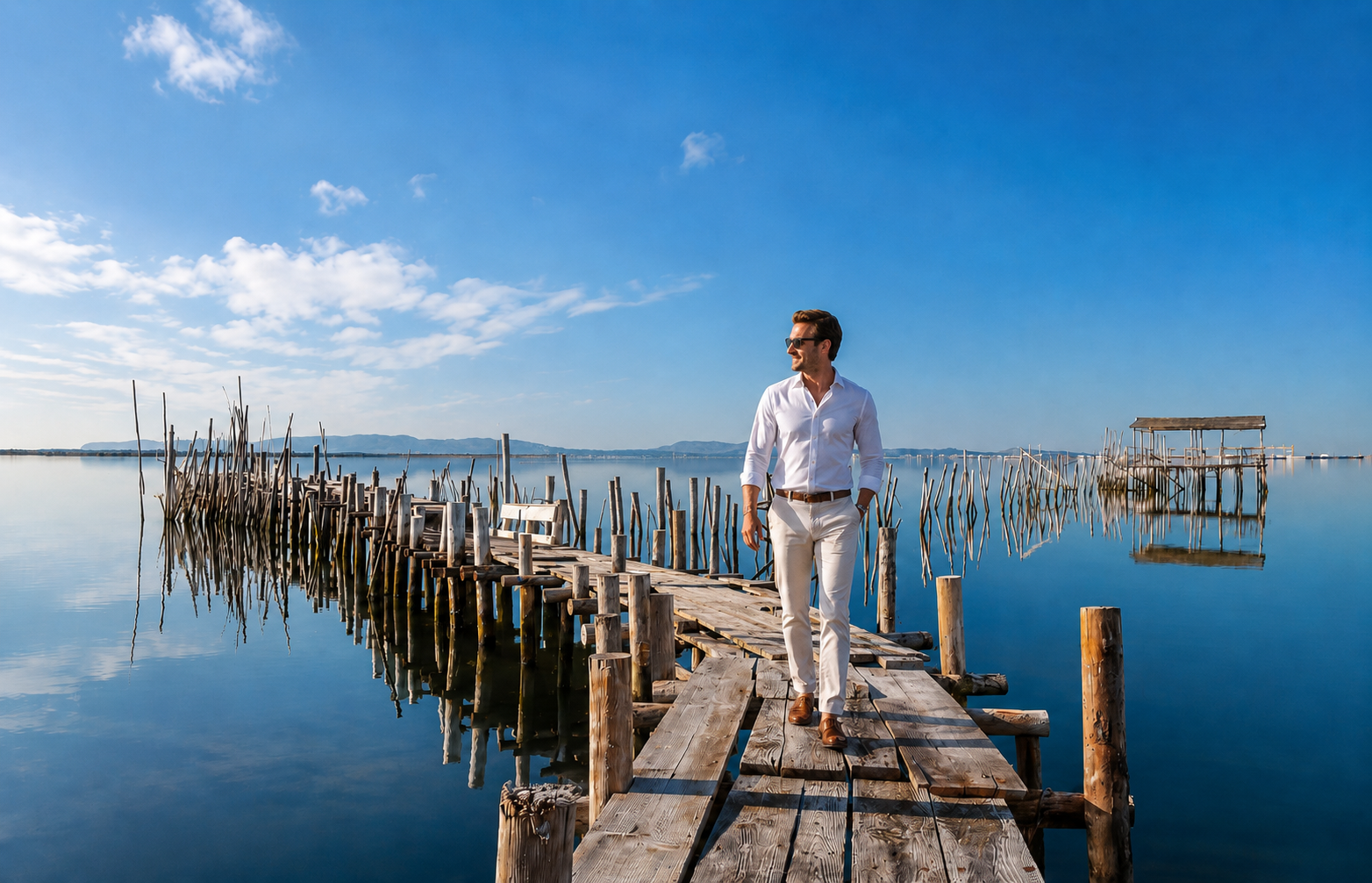
Visitors often arrive expecting an abandoned curiosity. You’ll find the opposite. Fishermen still mend nets here, still ready their boats and still work the estuary for fish, clams and oysters. They time their trips to the tide, the same way their fathers did.
Ask politely and you may buy fresh fish or shellfish straight from the boat.
This matters more than any photograph. The pier keeps doing the job people built it for.
Birdlife on your doorstep
The Sado Estuary Nature Reserve protects one of the richest wetland systems in Portugal. Counts of resident and visiting bird species run above 200, with some sources putting the figure past 250.
Watch for flamingos, white storks, herons and large numbers of ducks. The estuary serves as a nesting, resting and wintering ground for all of them.
The reserve also holds a resident population of bottlenose dolphins, one of very few estuary populations in Europe. Your walk along the pier comes with serious birdwatching attached.
The best time to arrive
The pier changes completely with the tide. Check tide tables before you drive out.
Late afternoon into sunset gives you the classic view. The rising water lifts the boats off the mud, the channels catch the low light, and Tróia, Comporta and the Serra da Arrábida sit on the horizon behind. Photographers gather for this window.
Mornings at low tide show you bare flats and near silence. Quieter, emptier and worth seeing in its own right.
Weekdays draw far fewer people than weekends.
Practical notes for your visit
Getting there. Drive. Public transport to the village is minimal. From the EN253 between Comporta and Alcácer do Sal, follow the signs down a short detour to the water. Informal parking sits near the entrance.
Safety. Watch your footing. This is a working structure with uneven planks, slippery boards and no railings anywhere. Keep small children close and hold onto them.
Respect. Stay on the walkways. Leave the boats, nets and gear alone. Take your litter with you. You are standing in someone’s workplace, inside a protected nature reserve.
Why the pier holds up
The Carrasqueira Palafitic Pier survives because nobody built it to be looked at. Tide, mud and necessity shaped every stake in the ground.
Stand on the planks as the light goes gold over the Sado, and you’ll understand why so many people call this weathered wooden maze the finest hidden gem in Comporta.






Leave A Comment