

Ask what the top of the travel market now pays most for, and the answer keeps landing on things that barely register in a photograph. A shoreline with no one else on it. A week with no schedule and no reason to check the time. A place past the reach of a signal, where no camera but your own is pointed at you. Not long ago that list would have described a budget problem. Today it describes the premium — the part of the market where prices climb fastest and demand holds hardest.
We tend to file this under “trend,” and the word does quiet damage. A trend rises, crests, and gives way to the next thing; to call quiet luxury a trend is to assume it will pass. It won’t, and the reason is structural. Quiet luxury is not a mood in how wealthy people travel. It is what surfaces when four deeper currents — one sociological, one demographic, one technological, one economic — all run the same way at once. Trends peak. Currents set a direction. This is the case for reading quiet luxury as the second.
The claim here is narrow, and, I think, hard to dodge. Quiet luxury will shape the next decade of high-end travel not because it looks refined, and not because the style pages blessed it, but because the meaning of luxury has already shifted underneath us — from having and showing toward time, attention, privacy, and restraint — and because the people, the capital, the technology, and the market are now all pushing that way together. The rest of this piece takes the four forces one at a time.
The status code is being rewritten
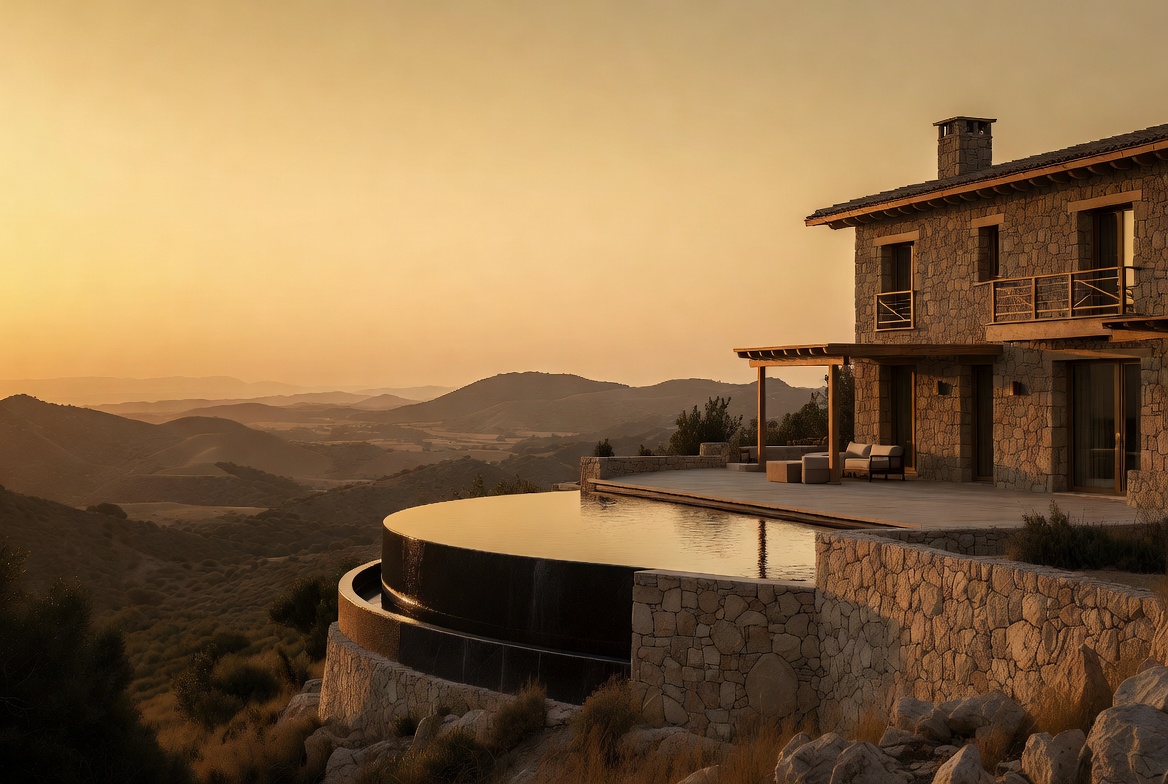
Begin with the slowest of the four, because it is the one most often misdiagnosed. Watching the rich trade logos for cashmere, people reach for easy explanations: the wealthy have grown modest, or guilty, or simply bored of shouting. None of that holds up. What is changing is not their character but the code — the grammar by which status gets communicated at all.
Thorstein Veblen named the old grammar more than a century ago. “Conspicuous consumption” described a leisure class advertising its rank through visible, costly, pointedly useless things. The logic ran clean through the twentieth century. Status was legible on sight: the watch, the car, the labelled bag, the suite whose view everyone could place. It worked because strangers could read it instantly.
The grammar broke when reading it got too easy. Analysts have a flat phrase for what befell logo-driven luxury: “logo democratization.” The markers that once sorted people into tiers — the monogram, the branded everything — turned imitable, financeable, rentable, until they sorted no one from anyone. A signal legible to all signals nothing. The genuinely affluent answered, as the sociologist Elizabeth Currid-Halkett has traced in her account of what she calls the aspirational class, by switching registers entirely: to inconspicuous consumption. Money moved toward the expensive but unseen — schooling, health, domestic help, cultural fluency, experience — goods that read as status only to those already holding the code. Veblen’s elite displayed wealth. Currid-Halkett’s displays information: the cloth whose quality only the hand confirms, the cut no passerby clocks, the address that means something to insiders and nothing to everyone else. The signal survives. It has simply gone dark to outsiders, on purpose.
None of this is invention; it is recurrence. Understatement as a class move traces back to the merchant and capitalist elites of the late eighteenth and early nineteenth centuries, who took up sober dress and plain interiors precisely to mark themselves off from the gaudy display of the old courts. The modern suit, muted and severe, is a fossil of that turn. Restraint as a status play is among the oldest gambits there is.
Point it at travel and the consequence is direct. The luxury signal is sliding from the photographable to the unphotographable. The infinity pool was a Veblen good — it existed to be seen, preferably by others, preferably online. What supplants it is whatever resists the frame: the access no one else can buy, the silence that will not photograph, the slow week that produces no content at all. And here the future sharpens the point. As a flawless image of the luxury life becomes something anyone can conjure with a phone and a model, the visible markers of wealth turn not just cheap but forgetable at scale. The only signals left standing are the ones that cannot be performed — real time, real access, real privacy, real presence. Quiet luxury is not ducking the status contest. It is relocating it to the one ground the coming decade cannot counterfeit.
The heirs already think this way
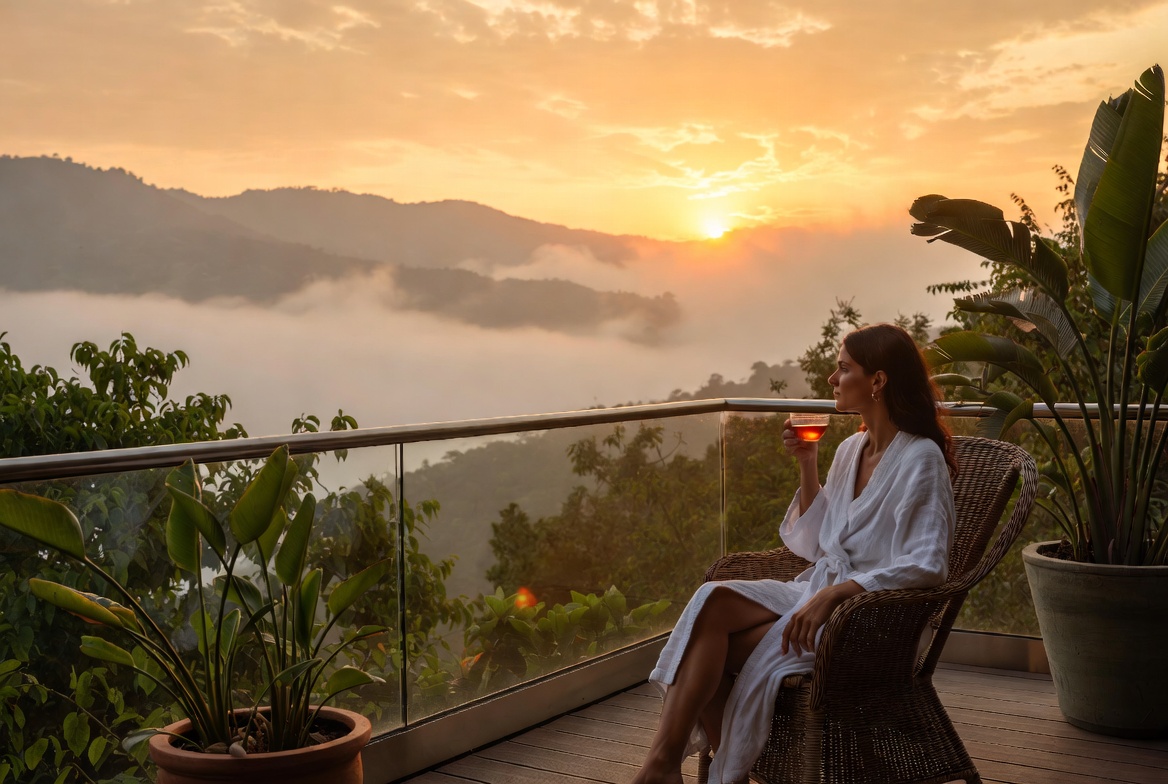
The second force is demographic, and it may decide the matter, because it is not about how people feel today but about who is about to hold the money.
We are at the leading edge of what banks have taken to calling the Great Wealth Transfer, the largest handover of assets between generations on record. The figure depends entirely on where you draw the time horizon, and the estimates scatter accordingly: roughly thirty trillion dollars changing hands within a decade on narrower readings, north of eighty trillion on longer ones, well past a hundred trillion by mid-century on the widest. Pick any single number at your peril; the direction is what counts. An enormous body of capital is passing from baby boomers to Generation X, to millennials, and in time to Gen Z — and these heirs do not hold the old ideas about what luxury is for.
The research says so with tiring consistency. Younger wealthy travelers reliably rank experience over acquisition, meaning over markers, privacy over being seen. They favor long stays over checklist sprints. They chase immersion and cultural depth, and they gravitate to operators whose values look like their own. Surveys of next-generation wealth — self-reported, so read them as directional rather than exact — find younger affluent travelers scoring discretion and exclusivity as spending drivers above the average, and framing their luxury spending as identity rather than scoreboard. The segmentation studies aimed at 2030 keep turning up the same figure: the traveler who is cash-rich and time-poor, ready to pay almost anything for flexibility, privacy, and a service that simply handles everything, because time is the thing they have least of.
That last part is where the demographic force meets the deeper argument. For a generation raised on infinite digital abundance and chronic time scarcity, the scarce good was never the object. It was the unbroken hour. Quiet luxury travel — one base rather than seven cities, the long lunch rather than the crammed itinerary, the staff ratio that hands your attention back to you — is just what luxury becomes once the people defining it have decided their scarcest asset is not money. The heirs do not need converting. They show up already believing it. As the wealth arrives in their hands across the next fifteen years, their preference stops being a niche and becomes the center of the market.
The analog dividend
The third force is the one that, to my mind, turns a strong case into an overwhelming one, because it is not steady — it is accelerating. Call it the analog dividend: the premium a more digital, more automated, more synthetic world attaches to whatever cannot be digitized, automated, or synthesized.
The background is familiar by now. Adults in rich economies spend, by various counts, something like seven hours a day on screens. Alerts arrive without pause; attention splinters into what researchers named continuous partial attention, a condition of monitoring everything and inhabiting nothing. The bodily toll — wrecked sleep, a raised stress baseline, shrinking spans of focus — has crossed from complaint to documented pattern, common enough that specialists increasingly treat it as a feature of the environment rather than a personal failing.
The industry has clocked all this, and its vocabulary gives it away. “Offline is the new luxury” is nearly a cliché in the trade now; one coinage doing the rounds, “hushpitality,” names properties that compete not on bandwidth but on the deliberate, advertised lack of it. Remote lodges list thin cell coverage as a selling point. Retreats take phones at the door. Disconnection, once the default condition of being alive, is now sold as the amenity, because for anyone who can afford the choice it has become the rarest thing in a day and therefore the dearest.
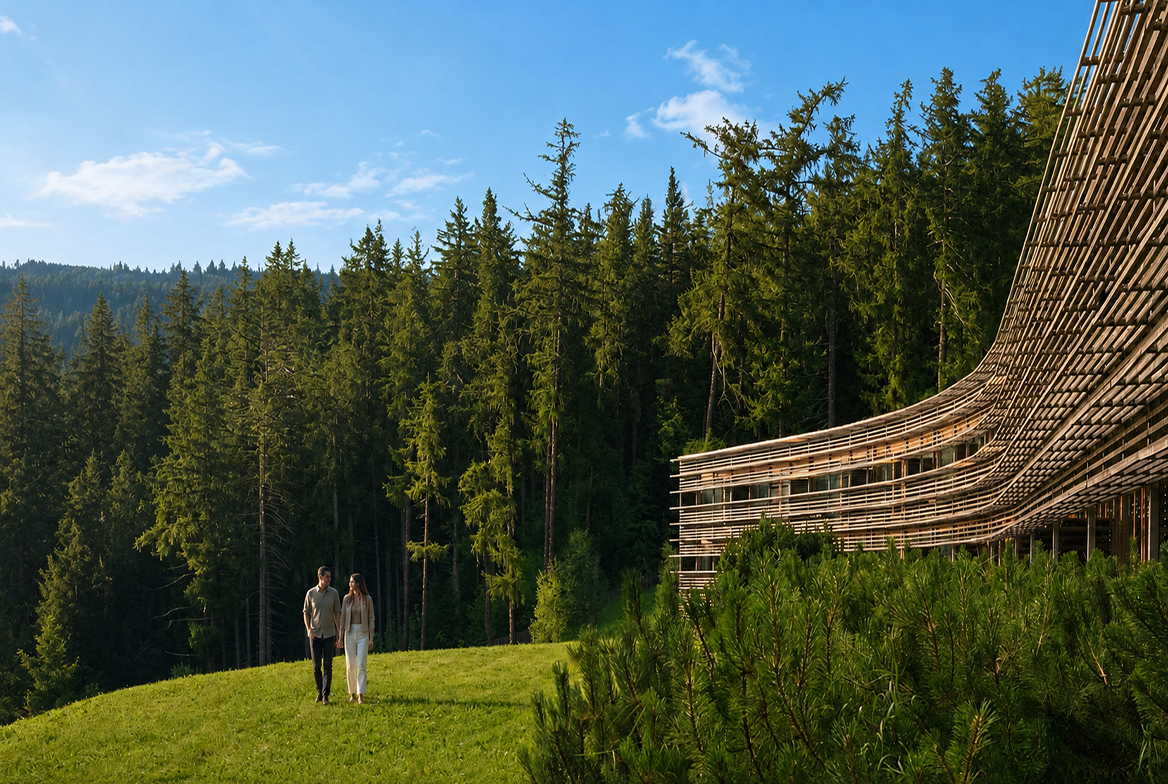
The most persuasive form of this is not a policy about phones. It is disconnection poured into the architecture. The Vigilius Mountain Resort, perched at around 1,500 metres on a wooded ridge above Lana in South Tyrol, is reachable only by cable car or on foot; there is no road, and guests leave their cars in the valley below. Matteo Thun built it to the motto “eco not ego,” a low structure of untreated wood, clay, stone, and glass that nearly vanishes into the larch, and once the last cable car has gone down for the evening there is no way off the mountain at all. This is not austerity — there is a spa, a kitchen leaning on local produce, some forty staff for a few dozen rooms. It is that the solitude is built rather than promised. You cannot slip away from the present moment, because you never drove in to begin with.
Here is why this force is the engine rather than a footnote. We are entering a stretch in which the digital world becomes not merely abundant but effectively infinite and synthetic — endless generated pictures, automated exchanges, machine-made everything. The old law has not moved: value tracks scarcity. As the artificial goes limitless and free, the scarce premium fastens onto its opposite — the embodied, the unmediated, the analog, the human, the present. A meal made by someone who knows your name. A morning with nothing on it and no signal to break it. Neither scales, automates, or generates. Each grows more valuable exactly as the world around it grows cheaper to fake.
Privacy sits in the same column. In an age of ambient surveillance, harvested data, and an internet that logs and ranks everything, the ability to be somewhere truly private — unwatched, unphotographed, off the grid in every sense — is turning into one of the defining luxuries of the wealthy. The fastest-growing slice of high-end lodging is the private villa and the standalone rental, and the reasons given most often are privacy, space, and personalization: the freedom to be fully somewhere without being watched, sold to, or seen. That is not sentiment about the past. It is a level-headed read on the actual conditions of the coming decade, and it tilts unmistakably toward the quiet end.
Scarcity cannot scale
The fourth force is economic, and it explains why the industry itself — not only its customers — is rebuilding around quiet luxury, under whatever name it prefers.
The wider luxury business has spent recent years inside a mood its observers label “luxury fatigue”: a tiredness, shared by aspirational and genuinely rich buyers alike, with the sheer omnipresence and hard sell of prestige brands. The mechanism is the one already described — dilute exclusivity with ubiquity and desire erodes even while the sales figures hold. Academic work on luxury “democratization” finds, across study after study, that widening a brand’s availability tends to lower purchase intent among its core buyers, because the pride of owning it rests on the exclusivity that wide availability dissolves. The houses that have ridden this out best are exactly the ones that leaned hardest into scarcity, craft, and discretion — the rarity principle, in the field’s own language, which holds that limited supply is not a tactic bolted onto luxury but the substance of the thing.
Travel runs on the same law, only more strictly, because real quiet luxury collides with physical limits that loud luxury never met. A logo mass-produces. Silence does not. Neither does space, nor an unhurried ratio of staff to guests, nor an unspoiled coastline, nor the hours it takes one attentive person to come to know one guest. These are capped by land, by labour, by attention, by the length of a day — inputs that refuse to scale. A hotel can bolt on another wing and call itself larger; it cannot bolt on another wing and stay quiet. The very things that give quiet luxury its worth are the things that fix the ceiling on its supply. That is not a flaw in the model. It is the whole economic reason it lasts. Scarcity you cannot manufacture, you cannot dilute; value you cannot dilute holds its ground.
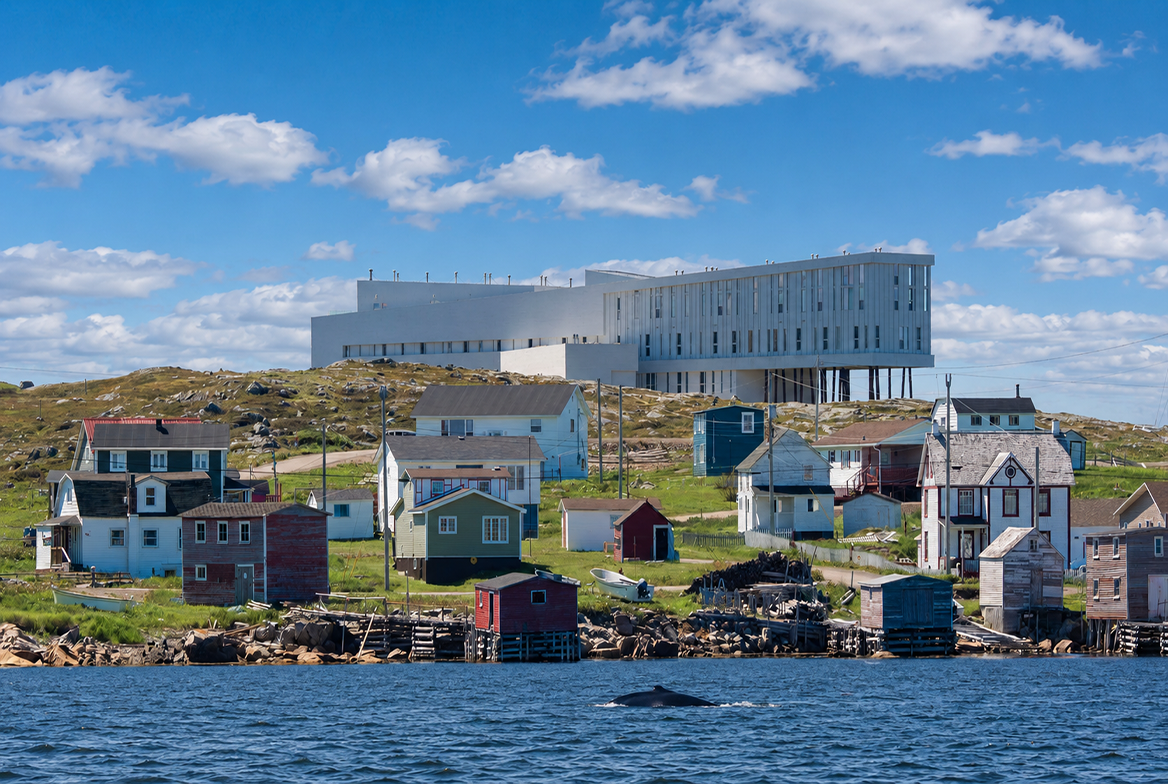
Take the extreme case. The Fogo Island Inn stands on a remote island off the northeast coast of Newfoundland, reached by ferry and a long drive, with twenty-nine rooms and no believable way to add a thirtieth and still be Fogo Island. It is there because the cod fishery that carried the island for centuries collapsed in the early 1990s; a returning islander, Zita Cobb, built the Inn through a charity, Shorefast, as a second leg for the local economy. Boat-builders turned furniture-makers, fishermen turned guides, and the operating surpluses go back to the island rather than to private owners — a flow the Inn publishes plainly through what it calls an “economic nutrition” label. None of this franchises. Its worth is bound up with its place, its people, and its smallness, and not one of those survives copying. Which is precisely why a stay there carries a meaning a bigger, replicable property cannot manufacture — and why it is the model, not the room count, that the next decade of luxury keeps reaching for.
The market numbers, messy as they are, lean the same way. Estimates of the luxury-travel market’s size swing wildly with what each analyst chooses to count — from under a trillion dollars to well over two — so treat any lone figure with suspicion. But across nearly every credible forecast, two things recur: the sector is set to keep growing through the early 2030s at a healthy pace, and its fastest-growing parts are the experiential and the wellness-oriented — the immersive, the restorative, the bespoke — rather than the plainly opulent. Within luxury travel, the money is moving toward depth, privacy, and experience, and away from spectacle. Supply is trailing demand, because that is where the durable margins sit.
What the future actually looks like
Set the four forces side by side and the shape of the coming decade resolves. The status code has already crossed from the visible to the invisible; the generation about to inherit the money is temperamentally committed to experience, privacy, and time; the digital saturation of ordinary life is making the analog and the unmediated the scarcest premium going; and the economics of scarcity mean the industry earns most by supplying just that. These are not four descriptions of one trend. They are four separate currents emptying into one channel.
The sharpest leading edge of where it goes is health and longevity as the ultimate luxury. The fastest-growing sliver of experiential luxury travel is the wellness retreat, and at the top it increasingly organizes around longevity — genomic screening, metabolic and hormonal workups, preventive medicine delivered on a serene private estate rather than in a clinic, at prices best read as a wide range rather than a figure. Strip out the science, some of it settled and some frankly aspirational, and the logic underneath is pure quiet luxury: the wealthy spending not to be seen but to buy back the one thing no money replenishes — time, in the most literal, biological sense. Once the ultimate luxury good is a longer, healthier life rather than a bigger, louder one, the direction of the whole sector is settled.
None of which means loud travel disappears. Spectacle will always sell; there will always be buyers for the visible, the brash, the photographed. But the prestige — the cultural verdict on what the best travel is — has already moved, and prestige is what the rest of the market eventually chases. The future of luxury travel is quiet not because the noise stops, but because the meaning has shifted, and everything downstream of meaning shifts with it.
The honest caveats
An argument that ran all this way without owning its discomforts would not deserve trust. So, plainly.
Quiet luxury is still consumption, and still exclusion. Currid-Halkett’s own point about inconspicuous consumption was never that it was virtuous; it was that it reproduces privilege more efficiently than the loud kind, precisely because it works through codes money alone cannot buy, which hardens class lines rather than easing them. The traveler who has “evolved” past logos to the quiet pleasures of a remote private estate has not left the status contest; they have moved it onto ground where their advantages are even harder to challenge. Restraint can be a real value. It can also be an alibi — a way to feel superior to display while spending more than ever.
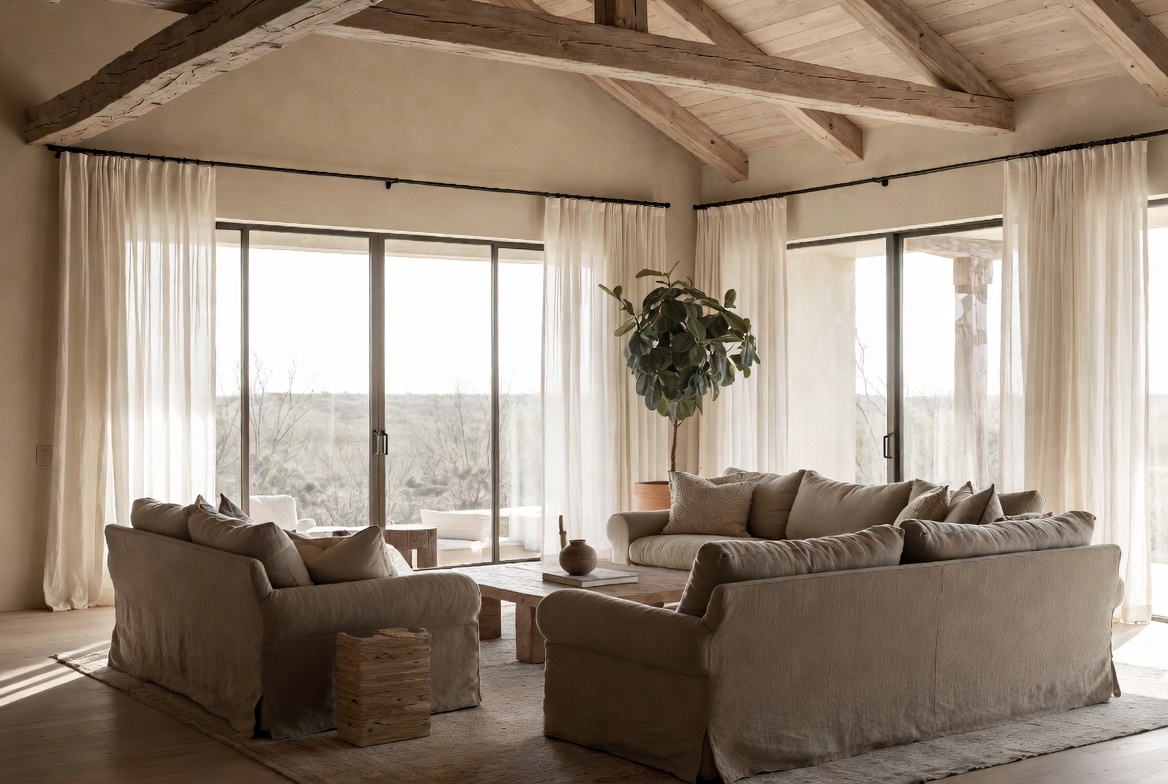
There is a risk peculiar to this moment: that “quiet luxury” curdles into a marketed look — beige linen, muted type, the word “intentional” — cut loose from the substance it is meant to name. The market has already begun selling the look of restraint, the vocabulary of disconnection, the signifiers of presence, while delivering none of the thing itself. A “digital detox” that turns out to be a juice menu by the same crowded pool; a “private” villa that is private in the brochure and overlooked in fact. As quiet luxury becomes the durable winner this piece argues it will be, the fakes will multiply, and separating the real article from the performance will become the central skill of the discerning traveler — a problem that deserves a guide of its own.
And none of it settles the wider ethics of high-end travel: the carbon, the strain on places loved past their limit, the plain asymmetry of a world where buying back your time and attention is an option for very few. At its best, quiet luxury is more sustainable and more humane than the alternative. But “at its best” is carrying real weight in that sentence, and to pretend otherwise would be its own kind of greenwashing.
The direction of travel
Weigh the caveats against the case and the conclusion still stands. The discomforts are reasons to be honest about quiet luxury, not reasons to doubt where it is headed. The four forces are real, structural, and compounding. The status code has been rewritten; the money is passing to people already inclined this way; the digital age is pricing the analog like treasure; and scarcity, the one thing money cannot manufacture, is the one thing this kind of luxury is made from.
What it amounts to is a redefinition that has, in fact, already happened — we are only watching it work its way through the market. Luxury used to mean more: more visible, more costly, more obviously so than the next person. It is coming to mean less, but truer: fewer places, gone into deeper; less seen, more felt; less owned, more lived. The travelers who will define the next decade have done the sum and reached the only sensible total. The most luxurious thing money can buy was never the loudest. It was the quietest — the time, the attention, the privacy, the presence — and that is exactly the direction all of travel is now moving.
This article draws on Elizabeth Currid-Halkett’s work on inconspicuous consumption and the aspirational class, read against Thorstein Veblen’s original theory of conspicuous consumption, and on the brand-prominence research associated with Han, Nunes, and Drèze; on industry analysis of “logo democratization” and academic studies of luxury democratization and the rarity principle; on reporting and forecasts around the Great Wealth Transfer from Capgemini, Altrata, Cerulli Associates, Coldwell Banker, and others, whose estimates vary widely by time horizon; on next-generation high-net-worth research and the Future Traveler Tribes 2030 segmentation; on luxury and experiential travel market sizing from Grand View Research, Fortune Business Insights, Allied Market Research, and related forecasters, treated as directional given the wide variance; on coverage of “offline as luxury,” digital-detox travel, and the attention economy; and on the World Luxury Chamber of Commerce’s future-of-luxury-travel research. Property details for the Vigilius Mountain Resort and the Fogo Island Inn, including the Shorefast social-enterprise model, come from the properties’ own published materials and independent reporting. Figures from self-reported surveys are best read as directional, contested numbers are given as ranges, and pricing is rendered throughout as ranges rather than fixed sums.

Leave A Comment