

Every wellness destination claims to be transformative. COMO Shambhala Estate has a better claim than most: it more or less invented the category it now competes in. Long before “wellness retreat” became a marketing phrase applied to any hotel with a juice bar and a yoga mat in the closet, this cluster of stone-and-thatch residences above the Ayung River was built as something else entirely — a private estate for a couple with money and a taste for Balinese craftsmanship. What it became, and how it has just spent a year and a considerable sum reasserting itself as the standard others are measured against, is the more interesting story now that the property has passed its twentieth year.
From private estate to wellness pioneer
The land’s story begins in the late 1990s, when Bradley and Debora Gardner, an American couple, spent over a decade building Begawan Giri Estate on a 22-to-23-acre plot of riverine jungle outside Ubud. It was conceived as a residential compound rather than a hotel — five architecturally distinct houses scattered through the forest, each built with a different regional influence and enormous quantities of imported stone and reclaimed teak. In the mid-2000s, Singaporean hotelier Christina Ong, founder of the COMO Group and by then already known for reinventing London’s Halkin Hotel and building the COMO Shambhala wellness brand from a single Singapore yoga studio, acquired the estate and rebranded it as COMO Shambhala Estate. The date most consistently cited for its relaunch as the group’s flagship wellness property is 2005, though the transition from private residence to retreat happened gradually rather than on a single reopening day — a detail worth noting given how many competing dates circulate in print.
What Ong inherited, and what her team has spent two decades refining, was a site with genuine spiritual weight in Balinese cosmology before a single guest ever checked in. The estate sits where the Ayung River meets a smaller tributary, the Tibakauh — a confluence traditionally regarded as a place of purification — and its hydrotherapy facilities draw from a natural spring on the grounds that villagers have considered healing for generations. COMO didn’t invent this significance; it built around it, which is a different and more credible kind of positioning than most resorts manage when they reach for the word “sacred.”
A year-long renovation, marking twenty years
The property reopened in July 2025 after a substantial renovation timed to its twentieth anniversary, and the timing matters for anyone deciding whether to book now versus in a few years: this is a retreat that has just been meaningfully upgraded rather than one coasting on reputation. The redesign, led by Atelier Ikebuchi — the Singapore-based studio behind the estate’s original interiors — introduced Carrara marble, black Corian cladding, and dark teak into the spa’s public spaces, alongside additions that a wellness property in 2005 simply didn’t need to offer: a cold plunge pool, an ice bath, an infrared sauna, a hyperbaric oxygen chamber, and a dedicated Ayurveda treatment space. Two of the five guest residences, Wanakasa and Bayugita, were fully renovated in the same push; the other three retain their original character.
The renovation is a useful test of whether COMO understands its own audience. Contrast therapy and hyperbaric oxygen are the current vocabulary of longevity-focused wellness travel, borrowed from biohacking and performance medicine as much as from Ayurveda. Layering that vocabulary onto a property whose founding language was Balinese spiritual tradition and Ayurvedic consultation could easily read as trend-chasing. Whether it does depends on execution — but the details suggest restraint rather than gimmick: the additions sit alongside the original programme rather than replacing it, and the design brief was explicitly to change as little of the architecture as possible.
The architecture: five elements, five residences
COMO Shambhala Estate has no single hotel building. It is organized instead as five multi-suite residences, each named and designed around a natural element, connected by paths that wind through jungle clearings and terraced hillside rather than corridors. Architect Cheong Yew Kuan, who also designed the Four Seasons Resort Seychelles, drew on Balinese, Sumbanese, and Javanese building traditions across the five structures, using alang-alang thatch, local stone, and teak throughout. Interiors are by Koichiro Ikebuchi of Atelier Ikebuchi, who has since worked across most of COMO’s Asian properties.
Tejasuara — Sanskrit for “Sound of Fire” — is the most architecturally dramatic, built from roughly 1,200 tonnes of stone shipped in from Sumba, with black bamboo furnishings and tribal textiles that read closer to a private collector’s retreat than a hotel suite. Tirta-Ening, “Clear Water,” takes the opposite register entirely: a Japanese-inflected water garden, a floating pavilion of yellow rock and teak, and a self-consciously zen restraint. Wanakasa, “Forest in the Mist,” is built as a treehouse cluster around a banyan tree, its suites elevated on Bingkirai-trunk columns a hundred metres above the river, with a semi-circular infinity pool that mirrors the curve of the valley below. Bayugita, “Windsong,” leans into colonial Javanese detail — Victorian antique tubs, Dutch colonial beds — layered onto a jungle-canopy setting. Umabona, “House of the Earth Son,” takes its architectural cues from Majapahit palace design and faces Mount Batukaru directly.
Each residence houses four to five suites arranged across a hierarchy of Terrace Suite, Estate Suite, and the top-tier COMO Shambhala Suite, sharing a communal pavilion, dining space, and a large infinity pool. It’s an unusual structure for a five-star property — guests staying in the same residence will inevitably cross paths at the shared pool and lounge — and it works in the estate’s favour precisely because it resists the anonymity of a typical resort corridor. You are, in effect, staying in someone else’s exceptionally well-designed jungle house, four rooms of it, not a numbered floor of a hundred-room block.
The wellness programme: from consultation to contrast therapy

The retreat’s real differentiator has always been depth of personalization rather than any single treatment. Guests begin with a consultation — historically with an Ayurvedic doctor, a nutritionist, or a traditional Chinese medicine practitioner, depending on what they’re seeking — and the resulting programme is built around that conversation rather than a fixed menu. The renovated Ojas Wellness Centre, now spread across the Ojas, Shikara, and Kedara zones, houses thirteen treatment rooms, a hydrotherapy pool fed directly by the estate’s sacred spring, yoga and Pilates studios, an indoor fitness centre, and an outdoor jungle gym with a climbing wall.
The post-renovation additions push the offering toward a more clinical, data-driven register: contrast therapy suites pairing cold plunge with infrared sauna, colonic hydrotherapy, and an Airpod hyperbaric oxygen chamber marketed for cellular recovery. Watsu — aquatic bodywork performed in the spring-fed hydrotherapy pool — is a newer addition to the water-based offering. For guests who want structure rather than an open-ended stay, the estate now runs a tiered system: short one-to-two-day Wellness Programmes (the COMO Cleanse for digestive reset, Tech-Inspired Wellness built around personal health data, Vital Energy combining qi-focused therapy with wellness technology) for shorter visits or newcomers, multi-night Wellness Paths built around a single focus such as gut health, detox, fitness, or Ayurveda, and six-night Signature Retreats — the Longevity Retreat, grounded in Ayurvedic principles, is the flagship example — for guests committing to a fuller reset. All levels include daily complimentary activities: sunrise and full-moon yoga, jungle stretch classes, and Balinese purification rituals are folded into every stay regardless of which paid programme a guest selects.
This structure is worth understanding before booking, because it changes what kind of trip you’re buying. A guest who books a suite with no wellness package attached will still find yoga, hiking, and the general rhythm of the estate, but the therapeutic depth — the consultations, the diagnostics, the sustained multi-day arc toward a specific goal — belongs to the Wellness Paths and Signature Retreats. Treating COMO Shambhala as a beautiful jungle hotel with a good spa, rather than committing to one of its structured programmes, means missing most of what distinguishes it from its (excellent) Ubud neighbours.
Cuisine as part of the treatment, not a concession to it
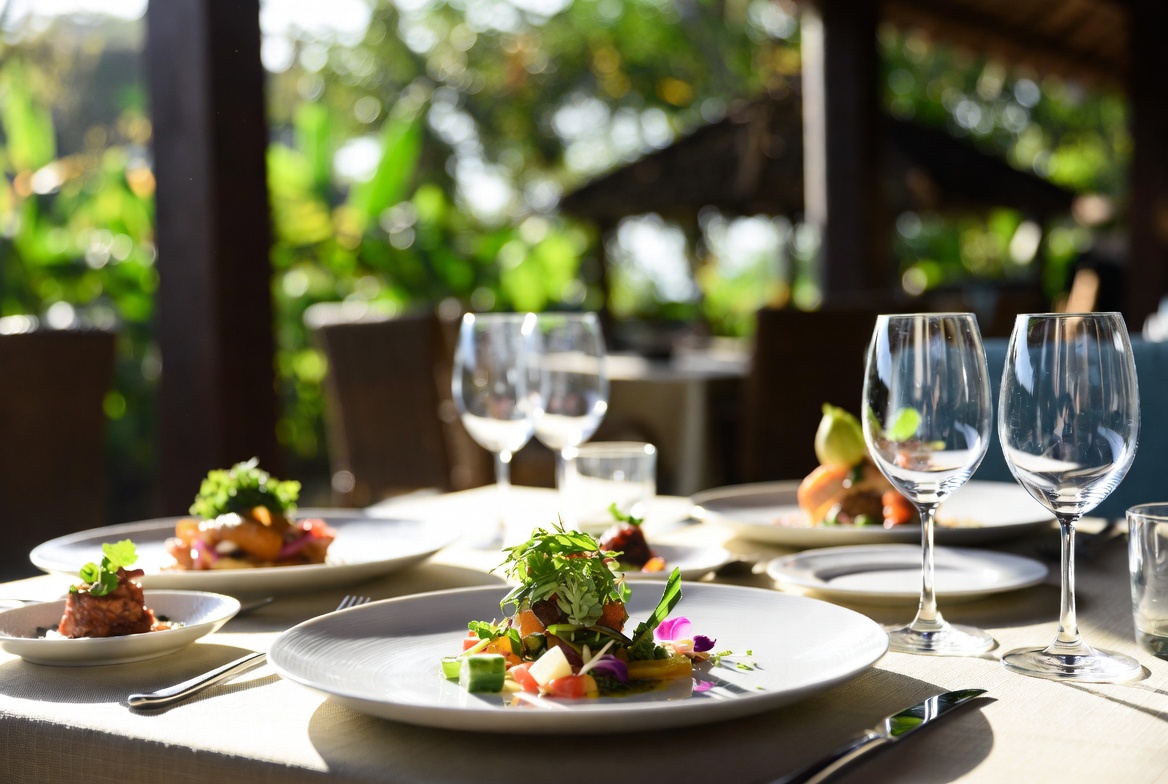
Dining at COMO Shambhala Estate is built around COMO Shambhala Cuisine, a house nutritional philosophy developed originally with nutritionist Eve Persack, oriented toward anti-inflammatory, largely plant-forward eating without tipping into restriction theatre. Glow, the all-day restaurant, is a light, open-kitchen space with dairy-free, gluten-free, and raw options built into every course rather than offered as an afterthought; Kudus House, a genuinely remarkable 150-year-old restored Javanese residence transported to the estate, handles breakfast and dinner with a menu drawing on Indonesia’s regional cuisines rather than resort-generic “Asian fusion.”
It is worth being honest about the trade-off here, because the house style at Luxe Tourist has never pretended every element of a luxury property works equally well for every guest. Several independent reviewers who’ve stayed at both COMO Shambhala Estate and its sister property COMO Uma Ubud have noted that the wellness-cuisine focus, however well executed, can read as narrow if you’re not specifically seeking that kind of eating — the health-forward orientation is a genuine editorial choice, not an oversight, and it will suit guests who came for exactly that far more than guests who happened to book the best-reviewed hotel in the area.
What a stay actually feels like
The rhythm most returning guests describe is consistent: morning yoga over the misty valley, a hike or the estate’s signature descent of roughly 2,200 steps down to natural spring pools at the base of the property, a spa treatment built around the morning’s consultation, and an evening that tends toward quiet rather than social. Personal assistants — not simply concierge staff, but dedicated attendants assigned per guest — handle logistics with enough discretion that the service disappears into the experience rather than announcing itself. The estate maintains a strict no-smoking policy across the property, with one designated exception near the spa pavilion, which tells you something about how seriously the wellness framing is enforced rather than merely marketed.
The property’s isolation is a genuine feature and, for some guests, a genuine limitation. This is not walking-distance-to-Ubud’s-restaurant-scene territory; the estate is roughly forty minutes from Ngurah Rai International Airport and separated from central Ubud by winding roads through rice terraces. Guests who want to combine a wellness stay with easy access to Ubud’s galleries, markets, and restaurant scene will find COMO Shambhala’s neighbours — Capella Ubud, Mandapa, Four Seasons Bali at Sayan — more convenient on that specific axis, even if none of them commit as fully to structured wellness programming.
Who this isn’t for
COMO Shambhala Estate rewards guests who arrive with an actual goal — a health reset, a specific practice they want to deepen, recovery from something — rather than guests seeking a conventional beach-and-pool Bali holiday with wellness amenities attached. The no-smoking policy, the health-forward kitchen, and the structured programme architecture all signal a property optimized for intentional stays rather than casual ones. Travelers who want nightlife, easy access to Ubud’s restaurant and gallery scene, or a more conventional luxury-resort register will likely be happier at one of the well-regarded properties nearby. And guests uninterested in committing to one of the paid Wellness Paths or Signature Retreats should understand they’re buying a beautiful jungle stay with strong spa amenities — genuinely excellent on its own terms — rather than the full transformative arc the estate is known for.
The practicalities
Rates vary widely by season, suite category, and whether a Wellness Path or Signature Retreat is attached to the stay; current published rates for standalone suites run roughly from the mid-hundreds to well over a thousand US dollars per night in high season, with the multi-night Wellness Paths and six-night Signature Retreats priced as inclusive packages layered on top of accommodation. As with any property where pricing shifts by package, season, and current promotional offers, treat any specific figure as a starting point for a direct enquiry rather than a fixed rate. The estate’s thirty suites across five residences mean availability is genuinely limited, particularly for the higher-tier COMO Shambhala Suites during peak Northern Hemisphere winter and summer travel windows.
COMO Shambhala Estate earned its “birthplace of a holistic wellness concept” reputation the hard way, by existing years before the category had a name, and the 2025 renovation is a reasonably convincing argument that it intends to keep earning it rather than simply trading on a twenty-year head start. For a guest who wants a jungle retreat built specifically for the work of resetting — not a hotel that happens to have a spa — it remains one of the very few properties in the world that actually delivers on the promise most others just borrow the language for.





Leave A Comment