

Quiet luxury is really a claim about scarcity. It holds that the scarce things are no longer gold leaf and obvious spend but time, attention, silence and space — and that the point of money, at the top of the market, is to buy back those things rather than to advertise it was spent. By that measure, Iceland barely has to try. It is a country with no talent for gaudy. The scenery is too vast and too geologically restless to be upstaged by anything a designer could add to a room, and what remains once you accept that is exactly what the luxury industry is now straining to manufacture: emptiness, weather, water, light, and the relief of being somewhere that asks nothing of you.
Most visitors never meet that Iceland. They meet the packaged one — a reel of waterfalls and a single crowded lagoon, moved through at volume. That version is real and it is busy. But beside it runs a quieter country, where a small number of properties and regions have grasped that the thing worth selling is not the view but an unhurried, low-density relationship with it, cleared of anything that would stand between a guest and the elements. Those are the places that repay the trip.
What “quiet luxury” actually means here
Elsewhere, quiet luxury is a styling choice: oat-coloured linen, logos stripped off, the volume turned down on purpose. In Iceland it is closer to a fact of geography. The land supplies most of it for free. Geothermal water warms the buildings and fills the pools; the silence is genuine because the next farmstead really is miles away; the light — the round-the-clock glow of midsummer, the green flare of the aurora — is nobody’s design feature.
The best Icelandic properties mostly add restraint on top of that. They build low, under turf, so the architecture sinks into the moss. They keep the rooms few. They set a hot pool under open sky and put a window where a television would otherwise hang. What you pay for is access and reticence — the chance to sit in warm water while a squall crosses the valley, with almost no one around to witness it. This is not cheap; Iceland is among the most expensive countries on earth to travel in, and honesty demands saying so. But the money buys solitude and contact with the elements rather than display, which is the exact bargain quiet luxury rests on.
The Retreat at Blue Lagoon: the polished flagship, with caveats
The obvious starting point is also the thorniest. In its public form the Blue Lagoon is the opposite of quiet — a pre-booked, high-throughput, milky-blue rite on the Reykjanes Peninsula, close enough to Keflavík to top and tail a trip. Yet set into the same lava field is The Retreat, which since 2018 has been Iceland’s first true ultra-luxury hotel and remains one of its finest.
It works by carving privacy out of the crowd. Its sixty or so suites give onto a residents-only lagoon, drawing on the same geothermal seawater as the public one. The centre of gravity is underground: a spa of roughly 2,300 square metres cut into an 800-year-old lava flow, dim and elemental, its treatment rooms let into raw rock. The suites are all broody Scandinavian discipline — timber, floor-to-ceiling glass, the greys and moss-greens of the land pulled inside. Its restaurant, Moss, carries a Michelin star and a Michelin Key. Expect rates comfortably above £1,000 a night for two, generally covering spa access, breakfast and afternoon tea.
Two honest caveats. First, this is a resort, not wilderness — minutes from the airport, and best used to decompress at either end of a journey rather than as a base for solitude. Second, and more importantly, the Reykjanes Peninsula has been erupting since 2021, with more than a dozen events along the Sundhnúkur crater row through 2025; the neighbouring town of Grindavík was evacuated in late 2023 and remains largely empty. The Blue Lagoon shuts at the start of each eruption and reopens once the authorities clear it — it stayed open for most of 2024 and 2025, and the last eruption ended in August 2025, though the cycle is expected to run on. Reykjavík and the airport, forty kilometres away, have been untouched throughout. None of this is reason to stay away, but it is a genuine variable: watch the Icelandic Met Office and keep the plan loose. The Retreat is remarkable, and it also sits on a seam where two tectonic plates are pulling apart — the honest recommendation says both.
Deplar Farm, Troll Peninsula: quiet by design
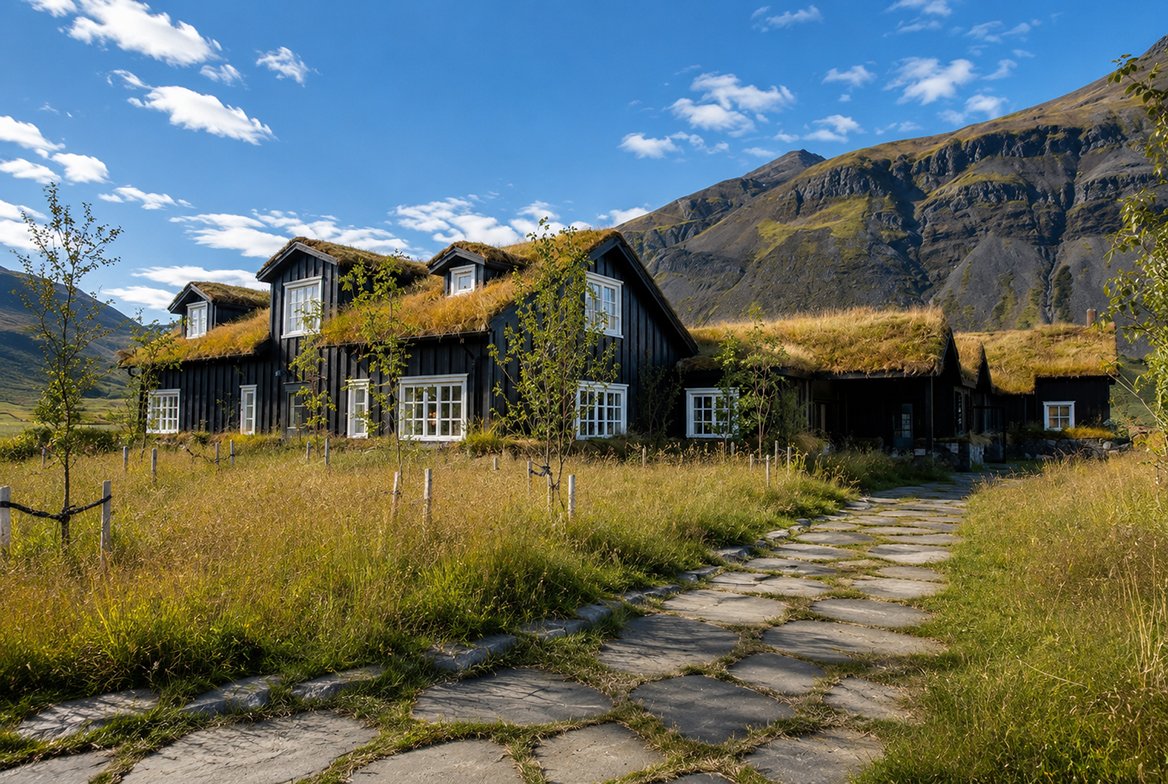
For solitude with nothing given up, the answer is Deplar Farm, an Eleven Experience lodge in the remote Fljót Valley on the Tröllaskagi — the Troll Peninsula — in Iceland’s thinly settled north. A former sheep farm under a turf-hidden roof, it holds only thirteen rooms, and its isolation is the whole idea: about ninety minutes from the regional airport at Akureyri, five hours’ drive from Keflavík, walled in by hard mountains and unpeopled rivers. The lodge’s own line is that the quiet is deliberate — you are here with the landscape, not inside a crowd.
Everything is included, in the full sense: chef-cooked meals, seasonal guided adventures, gear and planning all fold into a rate pitched at the very top of the market. The facilities amount to a private club for the outdoors — a geothermal pool with a swim-up bar, a spa with sauna and steam room, a yoga studio, a games loft, even a recording studio. The programme follows the calendar, from heli-skiing in spring to sea kayaking and horseback riding in summer to Nordic skiing and fat-biking in winter, each day ending at a fire and a soak.
What lifts it from merely expensive to quietly luxurious is the texture. There is a Viking sauna ritual built on the swing between deep heat and cold; an open-air pool to float in beneath the midnight sun or the aurora; and a coastal microclimate that, the lodge says, delivers clearer winter nights than much of the country, so that rather than chasing the Northern Lights you wait for them and let staff wake you when they come. It is adventure travel with the friction removed and the silence left in.
Torfhús Retreat: restraint as heritage

If any one place concentrates the whole argument, it is Torfhús Retreat, near Selfoss on the southern rim of the Golden Circle. From a distance all you see are black triangular roofs pushing up through the grass — the turf houses, torfhús, that name the place. They are a precise modern reading of the homes Icelanders lived in from the first settlements until the mid-twentieth century: walls of basalt from a nearby quarry, set by hand, roofed in living turf that flowers in summer and vanishes under winter snow. The nineteenth-century English designer William Morris noted these houses in his Icelandic journals; the ones here are their very comfortable heirs.
The detail worth pausing on is what turf meant. To the first settlers it was not rustic charm but a modest luxury — the only material that could insulate a house against a savage climate. Torfhús carries that forward. The retreat runs entirely on geothermal and hydroelectric power, the residences are built from reclaimed oak and local stone, and each has a basalt hot pool sunk into the ground, shared between the smaller Torfbær suites and private to the larger houses and the standalone villa. Meals are taken together in a Viking-styled longhouse. There is no spa wing, no marble lobby, no wealth on show at all. The luxury is the lineage and the quiet — a private pool under a milky midnight sky, the aurora over a valley far from any town’s glow. Few hotels make the case so cleanly that quiet luxury is less a trend than a tradition Iceland worked out from necessity.
The Highlands: Highland Base at Kerlingarfjöll
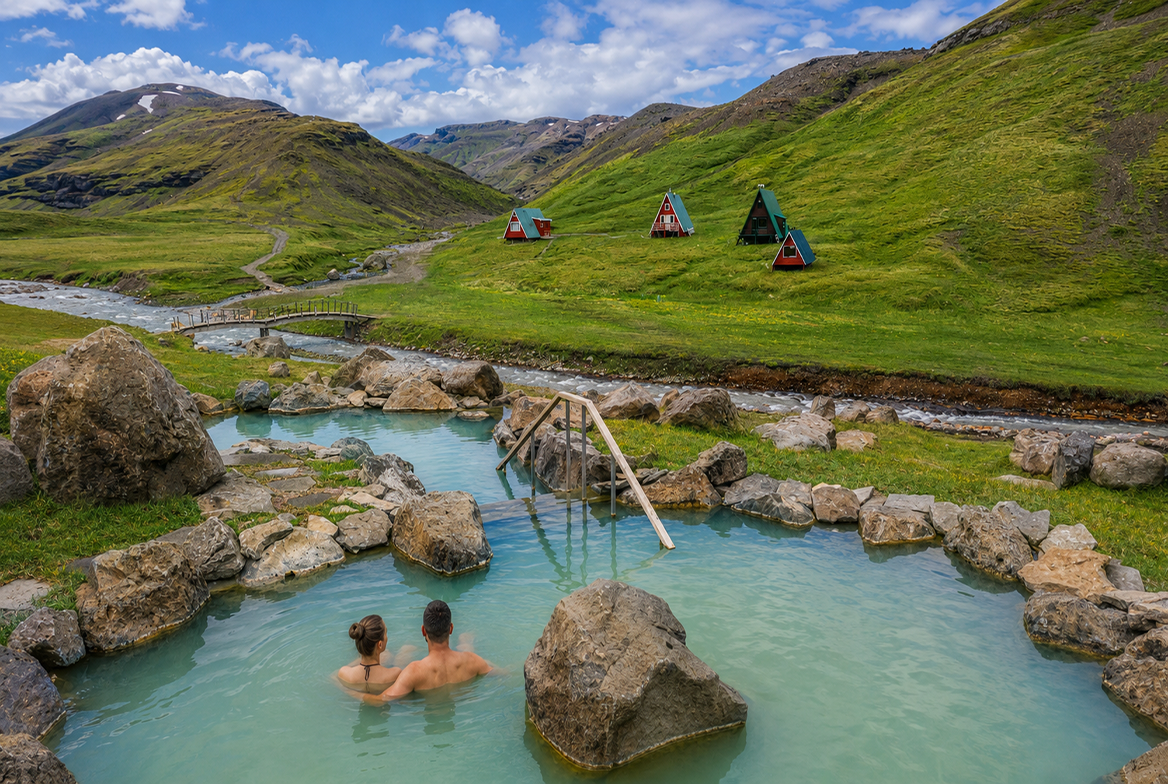
To go quieter still you head inland, into the central highlands that empty completely in winter and open only for the summer. Here, in the Ásgarður Valley at the foot of the Kerlingarfjöll mountains, Highland Base opened in 2023 as the interior’s first credible upscale outpost. The setting is the reason to come: a designated Protected Nature Reserve of rhyolite peaks, steaming geothermal valleys, glacial rivers and year-round snowfields, three to four hours from Reykjavík on summer tracks that see off ordinary hire cars.
The lodge is Nordic-spare — floor-to-ceiling windows, plain materials, and, by design, no televisions, since the view is the entertainment. Its smartest touch is practical: underground passages join the rooms to the restaurant and to the Highland Baths, a trio of hot tubs fed by the Hveradalir springs, so you can move between bed, dinner and a soak without ever meeting the weather. In winter a telescope stands ready for the night sky and for aurora-watching in real isolation.
Candour is due here too. Highland Base runs from campground and hostel huts up through deluxe rooms, suites and private lodges, and it is more a comfortable wilderness base than a flawless five-star hotel; the reviews are warm but not unanimous, and the rates are steep for what is, at bottom, a remote mountain lodge. What the money buys is position and access — waking inside one of the most dramatic and least-visited landscapes in Europe, soaking as steam lifts off the hills, exploring geothermal ground with no one else on it. Read as luxury-of-seclusion rather than luxury-of-opulence, it earns its keep.
Snæfellsnes and Hotel Búðir: the windswept country inn
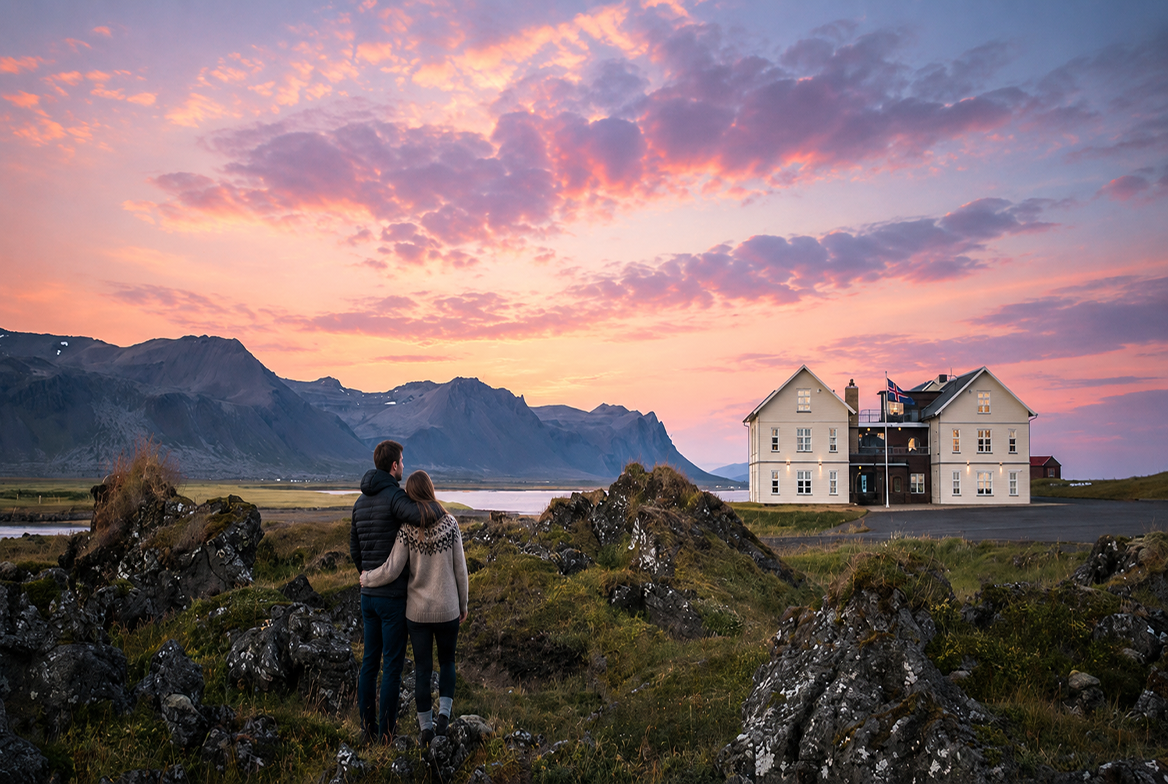
West of Reykjavík, the Snæfellsnes Peninsula gets called “Iceland in miniature” — glacier, lava fields, black beaches, fishing hamlets and birdlife folded into a couple of hours’ driving. Its quiet-luxury anchor is Hotel Búðir, standing alone at the edge of the Búðahraun lava field, Atlantic on one side, the Snæfellsjökull glacier in view.
Búðir is the opposite of the engineered resort, and better for it. It started as a seventeenth-century trading post — Búðir was once one of the peninsula’s busiest ports — and has run as a family inn since 1948; rebuilt after a fire, it kept its rough character of hardwood floors, dark woods and fireplaces across roughly twenty-eight individually designed rooms. Its only close neighbour is the small black timber church, Búðakirkja, photographed to death against the lava and the sea. There is a serious restaurant working modern Icelandic produce, a lounge with a telescope for birdwatching, and, in winter, some of the clearest aurora skies in the west. The nearest town is twenty minutes off; Reykjavík, about two hours.
The honest note, which nearly every guest repeats, is the weather: this is an exposed headland, and Atlantic gales can shake the building and rewrite a day. Light sleepers should pack earplugs. But that exposure is the draw. Búðir is luxury as a beautifully run country inn at the edge of the world, where the indulgence is a fire, a long dinner, a local dram and a landscape performing for almost no audience.
The new architecture of bathing
No survey of quiet luxury here can skip the defining ritual: the geothermal soak. The Blue Lagoon made it famous and then made it crowded, but the more interesting development of recent years is the run of design-led baths that have carried the experience out across the country, each one an argument that the highest luxury on offer is unhurried time in warm water with a view.
Outside Reykjavík, Sky Lagoon (2021) stages a seven-step ritual around a seventy-metre infinity edge that melts into the Atlantic. In Hvalfjörður, forty-five minutes north, Hvammsvík (2022) drops the polished-spa idea entirely: eight shoreline pools whose temperature and level move with the tide, the sea washing in at high water. Near Akureyri, the Forest Lagoon (2022) — from the architects behind the Blue Lagoon — sets two infinity pools above a fjord inside a rare stand of woodland. Far east near Egilsstaðir, Vök Baths floats hexagonal pools on a lake, with ladders into the cold and the only geothermal bathing water in Iceland certified safe to drink. And in Húsavík, GeoSea perches sea baths on a clifftop above the whale-watching bay.
The reason to catalogue them is not to prescribe a bathing crawl but to make the wider point. Together they add up to a national infrastructure for doing nothing, beautifully — for treating a long soak as the centre of the day rather than a footnote to it. In a travel culture fixated on covering ground, Iceland has quietly built a case for stillness, and the properties above are simply private versions of the same instinct.
Practicalities: when to go, how to move
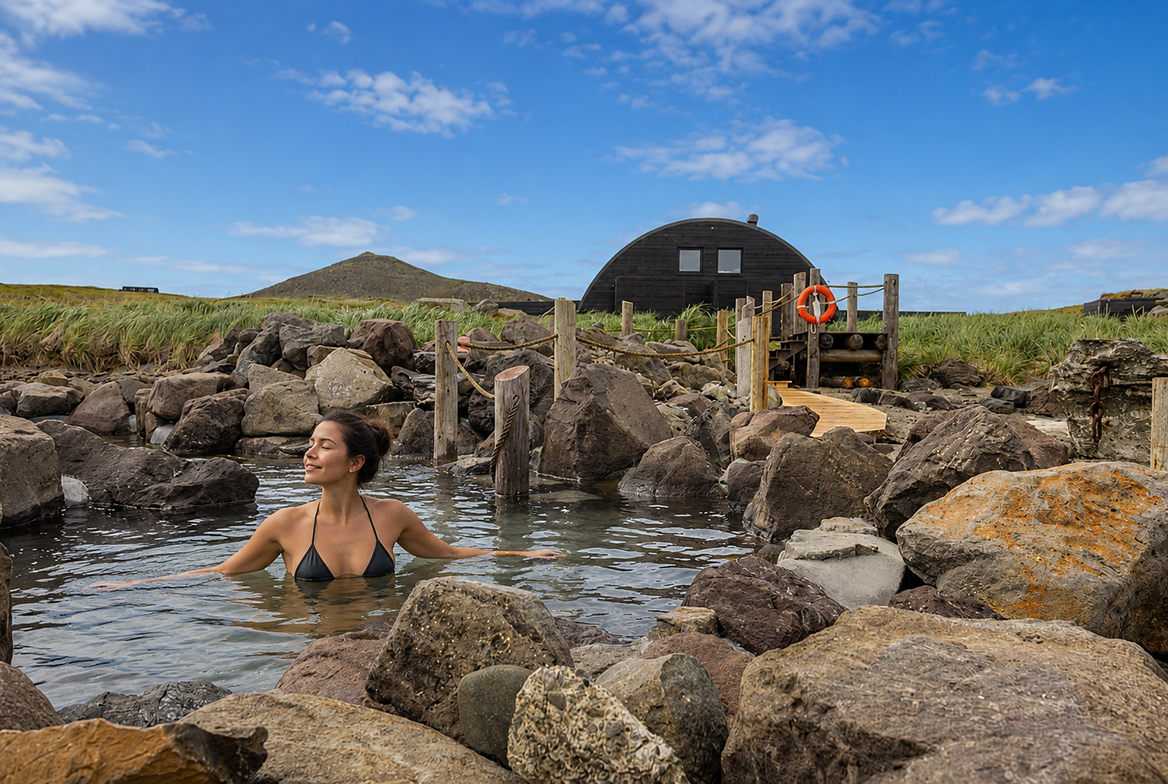
Iceland runs on two seasons that feel like separate countries. Midsummer, roughly late May through July, brings near-endless daylight, open highland roads and the freedom to drive the Ring Road or reach the interior; it is the season for Snæfellsnes hikes and highland lodges. The aurora season, broadly September through March, brings long dark, snow and the green light that pulls people north — the time to favour Torfhús, Deplar and Búðir for their black skies. The shoulder months of May and September usually strike the best balance of access and emptiness.
A few logistics to hold onto. The interior’s F-roads, the route to Kerlingarfjöll among them, open only in summer and demand a proper four-wheel drive; Highland Base runs transfers from Reykjavík, the wiser choice given what those tracks do to a rental. Volcanic activity on the Reykjanes Peninsula affects the Blue Lagoon area and little else; check safetravel.is and the Icelandic Met Office before booking anything near Grindavík, and treat the rest of the country as unaffected. And as a Schengen member, Iceland will fall under the EU’s new ETIAS travel authorisation for visa-exempt non-European visitors once it takes effect; the timeline has slipped more than once, so confirm the current rules close to travel.
Who this is not for
This is not a place for anyone wanting guaranteed warmth, a beach or a predictable schedule; the weather is in charge, and it changes plans. It is not for anyone whose idea of luxury needs visible opulence, a grand lobby or a city’s worth of nightlife — Iceland has almost none of that, by nature and by choice. It is among the most expensive countries anywhere to travel, so it rewards a focused trip over a sprawling one. And the volcanic and meteorological wild cards mean it suits people who can hold an itinerary loosely. For everyone else — those who read silence, weather and water as the real luxuries — few places deliver them so completely.
That is the case for Iceland as a quiet luxury destination. It does not so much redefine luxury as time, attention and restraint as remind you those were always the scarcest things, and that here they arrive not as a marketing line but as the only honest way to build. The properties worth the trip are the ones that understood it and stepped out of the landscape’s way






Leave A Comment