
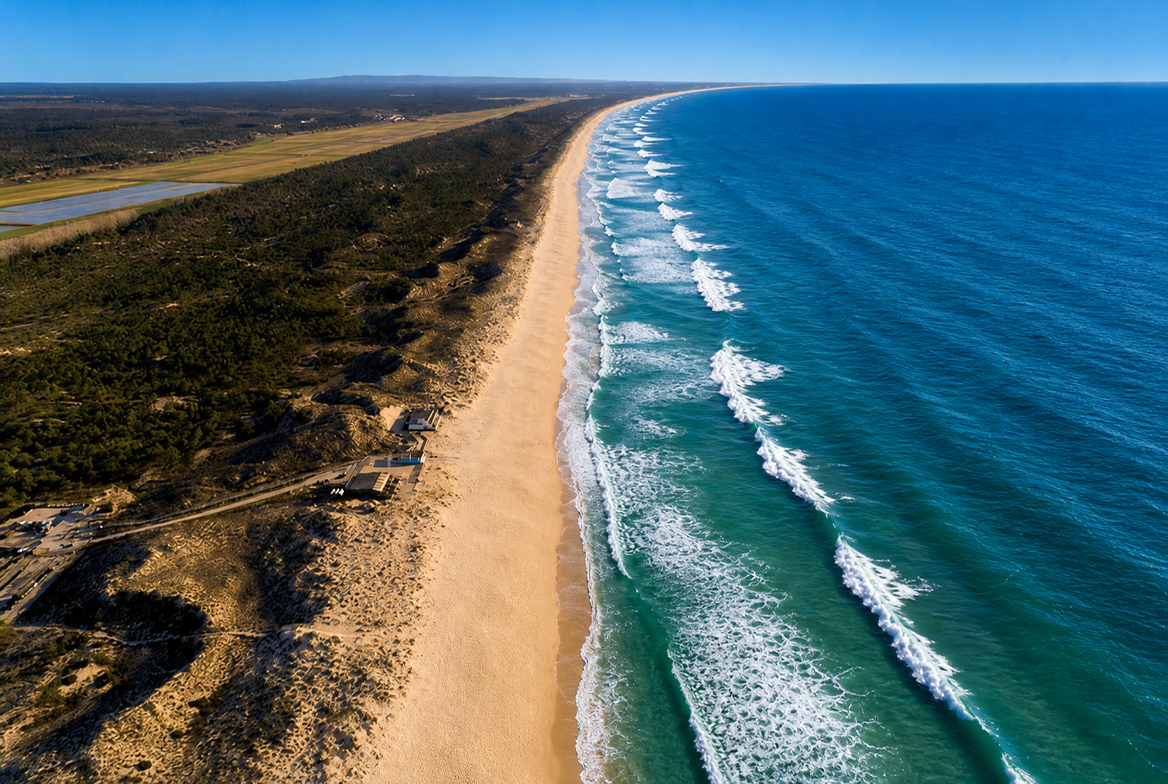
Some places demand attention. Comporta does the opposite.
It sits an hour south of Lisbon, where the Sado estuary meets the Atlantic at the foot of the Tróia Peninsula. For decades, Lisbon families have slipped away here on weekends. Fashion designers and private buyers chose it because no one was watching. People call it the “Hamptons of the south,” but the label undersells how quiet it stays. No high-rises. No boardwalk. No neon.
Building within 500 metres of the shoreline has long been restricted. The rule kept the coast low and gave the area its barefoot look. Restraint is the local style, set by law as much as by taste.
What you get instead is texture. Green rice paddies flood in spring. Umbrella pines and cork oaks. Pale honey dunes. Whitewashed cabanas with thatched roofs. Around 60 kilometres of near-empty white sand run from Tróia toward Sines.
Quiet luxury here is not a slogan. It is the working temperature of the place. The point of Comporta is to do little, and to do it well.
This seven-day plan is built for that. You will eat well, sleep somewhere with soul, ride a horse through a rice field, watch the sun set from a fishermen’s pier, and otherwise resist the urge to fill every hour. Slow is the strategy.
Before You Go: The Lay of the Land
“Comporta” means two things. It is a single village. It is also the wider Herdade da Comporta, a roughly 12,500-hectare estate the Espírito Santo banking family assembled in the 1950s. The estate holds seven villages: Comporta, Pego, Carvalhal, Brejos, Torre, Possanco, and Carrasqueira.
Each village has its own character. Carvalhal and Comporta village hold most of the shops and restaurants. Carrasqueira keeps the old fishing soul. Pego and Carvalhal anchor the beach scene. The best trips move between them.
Getting there. The nearest airport is Lisbon (LIS). You have two good options. Rent a car either way, because public transport is thin and taxis run out fast in summer.
The direct route is to drive. Count on about 1 hour 15 minutes via the A2 and A12 motorways, exiting toward Alcácer do Sal or Grândola, then taking national roads to Comporta.
The scenic route runs through Setúbal. Drive there in roughly 35 minutes, board an Atlantic Ferries car ferry across the Sado to Tróia, and finish with a 13-kilometre drive south. The crossing takes 25 minutes and runs about hourly, more often in summer. The estuary holds a resident population of bottlenose dolphins, so watch the water on the way over.
When to go. May to September gives you reliable beach weather. Spring and early autumn trade some heat for empty beaches and flooded, newly planted paddies. One warning: the rice fields breed mosquitoes in high summer, so pack repellent.
Day 1: Arrival and the Art of Settling In
Do nothing on your first day. Comporta rewards arrival, not a schedule.
Where you stay shapes the whole trip. Sublime Comporta is the region’s anchor. It spreads across a 17-hectare estate under tall umbrella pines. Rooms, suites, and cabana-style villas sit far apart, many with private plunge pools and fireplaces. Over the years it grew into a small village, with a spa, several pools, a beach club, and a set of restaurants. The design follows the local rule: natural materials, neutral colours, local artisan work, nothing loud.
If you prefer wellness and design, book Quinta da Comporta in Carvalhal instead. It opened in 2019, designed by architect Miguel Câncio Martins on a former rice estate. It faces the Carvalhal paddies directly, with an infinity pool set into the fields at sunset. The property doubles as a quiet gallery. A Joana Vasconcelos sculpture hangs above its Inari restaurant. A Vhils piece honours the women who once harvested the rice. Its Oryza Spa builds treatments around rice, grains, and herbs grown on-site.
Either way, spend the afternoon by the pool. Then eat your first dinner at the hotel. At Sublime, dinner means Sem Porta, a glass-fronted dining room listed in the Michelin Guide. The kitchen reworks Alentejo and Portuguese cooking with produce from the hotel garden and fish from local boats. Smoked eel. Turbot with creamy rice. Iberian pork. Order a cocktail at the bar and turn in early.
Day 2: The Beaches, Properly
Today you learn what people mean about the sand.
Comporta’s beaches share one long stretch of dune-backed coast, but each has its own personality. Praia da Comporta is the broad classic nearest the village. Praia do Carvalhal feels more rustic and holds much of the good eating. Praia do Pego has a touch of glamour. Praia da Torre and the wilder Aberta Nova reward anyone willing to wander.
Start with breakfast at the hotel. Drive to Carvalhal mid-morning, claim a sunbed, and settle in. Swim, read, doze, repeat. The water runs cold and fully Atlantic, not a warm Mediterranean swim. The sand is the softest and palest in Portugal.
Lunch is the main event, and it should run long. Restaurante Sal is the region’s icon. After more than a decade on Praia do Pego, Sal moved in 2023 to Praia do Carvalhal, into the former site of the old fishermen’s restaurant O Dinis. The formula holds: bleached wood, bare feet, cold white wine, clams steamed in garlic and white wine, grilled fish, and a deep arroz de marisco. Book ahead, above all on weekends, when Lisbon arrives.
Spend the rest of the day on the sand. When the light softens, you have one more stop.
Day 3: Carrasqueira, Storks, and the Old Comporta
Give a morning to the Comporta from before the design boutiques: the working, fishing, rice-farming Alentejo.
Start at the Cais Palafítico da Carrasqueira, the palafitic pier. Local fishermen built this zig-zagging boardwalk on wooden stilts in the 1950s and 1960s, so boats reached the dock at low tide. It is one of the last of its kind in Europe and one of the most photographed sights in the region. Come at the start or end of the day, when the light turns amber and the mud flats glow. Fishermen still use it, so you walk through a live tradition.
From there, move into the Sado Estuary Nature Reserve, a protected wetland full of storks. You will see their large nests on poles and chimneys across the area. Flamingos appear in season. Bring binoculars if you watch birds.
For lunch, lean into the local grain. Museu do Arroz, the “Rice Museum,” sits in a restored rice-husking factory outside Comporta village, ringed by the estuary. Its menu honours rice in every form: clam rice, cuttlefish rice cooked in its own ink, duck rice. The tidal docks beside it look best at sunset. For a beach version of the same theme, try Ilha do Arroz on Comporta beach.
Save the late afternoon for Comporta village, a small grid of blue-and-white buildings ringed by storks’ nests. Browse the boutiques that made the place famous: ceramics, linens, rattan, olive oils, tinned fish, and easy resortwear worth an extra suitcase. End with a sundowner at Comporta Café on the beach, where colourful chairs, hammocks, and a glass of house white sangria are close to a local habit.
Day 4: Horseback Through Rice Fields and Dunes
One experience sums up Comporta. This is it.
Book a morning ride with Cavalos na Areia, the area’s best-known stable, based on the EN261 at Torre. The route runs through the rice paddies, crosses dune, and ends on the wide empty sand of Praia da Torre. Rides last about 90 minutes and welcome beginners, since the horses stay calm and the guides watch closely. Experienced riders pay extra for a private session and canter along the shore. Group rides start around €60 per person. Private rides cost more. Go early, before the heat and the crowds. Many guests rate it the best thing they did.
Back at the hotel, take a long lunch by the pool and an afternoon of nothing. A good ride earns a good nap.
For dinner, switch register and head to Cavalariça in Comporta village. It sits inside a former horse stable, with booths tucked into the old stalls. It holds a Michelin star for creative, produce-led sharing plates linked to chef Ljubomir Stanišić. Roasted cauliflower with coconut milk. Inventive vegetable dishes. Sharp cocktails. Tables are limited and demand runs high, so book well ahead.
Day 5: A Day Trip to Melides
By now you have your Comporta rhythm. Good time to see what lies past it.
Drive about half an hour south to Melides, a quieter village with an artsy streak. Its beach, Praia de Melides, and the freshwater Lagoa de Melides stay far less busy, ideal for an off-grid picnic. The village has grown a small design and ceramics scene. Walk the streets, look for studios and concept stores like Vida Dura, and see the local pottery tradition at the Olaria and Museu do Barro.
Most design-minded travellers come for Vermelho, the five-star boutique hotel Christian Louboutin opened in Melides in 2023. Inside, it feels like the designer’s private collection: 13 individually designed rooms, antiques and art at every turn, hammered silver-leaf surfaces, colourful gardens, and an Indian-inflected lounge. If you are not staying, time your visit for lunch or dinner at Restaurant XTian, run by chef David Abreu, or a drink at the Vermelho Bar. It is the most maximalist thing in a region built on restraint, and better for it.
Drive back in time for sunset. After a few days here, you will treat sunset as a fixed appointment.
Day 6: Water, Wine, and Wellness
Mix the elements today.
If you feel active, give the morning to the Sado estuary, this time on the water. Charter a small boat or catamaran, look for the resident dolphins, pass the coves toward the Arrábida coast, and swim somewhere empty. Surfers will find steady beach breaks. Carvalhal works well when conditions line up, and local schools around Pego teach every level. Kayaking and cycling through the flat, scented country suit a slower pace.
If you would rather stay still, spend the day at a spa. Quinta da Comporta’s Oryza Spa leads, with rice-water rituals, a hammam, a sauna, and a glass-fronted hydrotherapy pool over the paddies. Sublime’s spa matches it.
Give the late afternoon to wine and food. The Alentejo is one of Portugal’s great wine regions, and the coastal estates planted vines in the sandy soil. Book a tasting at the Herdade da Comporta winery to taste the local terroir. For dinner, go local at Dona Bia, an institution on the EN261 serving classic Portuguese cooking for years: grilled fish, seafood rice, cataplana. Unpretentious and generous. The opposite of the design crowd.
Day 7: A Slow Goodbye
Do not rush the last day. In Comporta, the ordinary morning is the luxury.
Take a long breakfast. Walk the beach early, when the sand runs cool and the storks and surf keep you company. If a boutique held your eye, go back and buy the thing. Take one last swim.
For a final meal, return to the beach for lunch at the Sublime Comporta Beach Club, or revisit a favourite from earlier in the week. Then take the easy drive, or the prettier ferry back through Tróia and Setúbal, toward Lisbon. Watch for dolphins.
You will leave with few photos of “sights” and many photos of light: on water, on sand, on the green of the rice. This is the point. Comporta gives you no checklist to conquer. It gives you a tempo to keep, and quiet proof: unstructured time in an unhurried place is the real luxury.
Practical Notes
Book ahead. The best restaurants, Cavalariça, Sal, Sublime’s beach club, and Vermelho’s XTian, stay small and busy, above all on summer weekends. Reserve early. Many hotels and villas book tables through their concierge.
Rent a car. The region is small and easy to drive, but spread out, and taxis run short. A car makes the whole coast reachable.
Pace your meals. Lunch here is often the main meal and often runs several hours. Plan each day around one long table, not three rushed ones.
Respect the quiet. Comporta’s appeal is deliberate. Low-key dress, low voices, and a slower pace are not only manners. They are the reason the place is worth the trip.
Restaurant locations, hotel offerings, ferry schedules, and seasonal openings change often. Confirm details with venues before you travel.

Leave A Comment