

Watch a certain kind of traveler check into a farmhouse in the Alentejo or a timber lodge in the Faroes, and the wardrobe does something strange: it just works. The same knit shows up at breakfast, at a coastal walk in the rain, and at dinner under a blazer, each time looking like the obvious choice rather than a repeat. Nothing creases. Nothing has a logo. Nothing looks like it was bought for the occasion. That isn’t luck or an eye for style alone. It’s a system, and the system is older, and more technical, than most people assume — built on 1970s London tailoring, a single 1985 fashion collection, and a fair amount of fiber science.
The idea has a lineage
1970s, London. A boutique owner named Susie Faux, whose shop was called Wardrobe, gave the concept its name: a short list of essential, well-made pieces — trousers, a skirt, a coat with weight to it — meant to survive fashion cycles rather than chase them, refreshed with the odd seasonal addition instead of torn down and rebuilt each year.
1985, New York. Donna Karan carried the idea to a much larger audience with “Seven Easy Pieces,” anchored by a single black bodysuit that could be layered a dozen different ways across a working week: a wrap skirt, a tailored jacket, a cashmere sweater, a leather piece, something for evening. Every item was designed to talk to every other item. The problem she was solving was a woman needing to look finished without owning, or hauling around, a wardrobe’s worth of unrelated outfits.
Today, anywhere. That is, at bottom, the same problem a trip presents. A suitcase is a week of a life, compressed, with a weight limit attached. Quiet luxury’s own rise as an aesthetic — away from logos, away from the visible spending that felt gauche after 2008 — has been well covered elsewhere. What’s specific to travel is narrower: the same restraint that defines a quiet luxury wardrobe at home, tonal neutrals and serious fabric and nothing that announces itself, turns out to solve the packing problem better than almost anything else on offer. Restraint and portability are, in practice, the same habit under two names.
Why fewer choices produce better outfits
The ease a good capsule delivers isn’t purely a matter of taste. Barry Schwartz’s research on choice overload, laid out in The Paradox of Choice, found that past a certain point, additional options don’t add satisfaction; they add anxiety and regret. A well-known related experiment, run by Sheena Iyengar and Mark Lepper, found shoppers bought far more often when offered six jam varieties than twenty-four.
- Packing fifteen loosely related items isn’t packing more options, it’s packing more decisions — decisions that will get made half-awake, in an unfamiliar hotel room, at exactly the moment they’re hardest to make well.
- A capsule of ten to twelve pieces built to combine removes the decision before it starts. The outfit gets assembled rather than chosen, which is Schwartz’s “satisficing” in practice: pick something good, move on, instead of relitigating between near-identical shirts.
- The logic is combinatorial, not additive. Twelve pieces built around a single palette, where any trouser works with any top and any top layers under any coat, can generate several dozen outfits. Twelve pieces bought without that discipline, mixing colors and silhouettes that don’t speak to each other, might generate four.
The fabric question is a science question, not a taste question
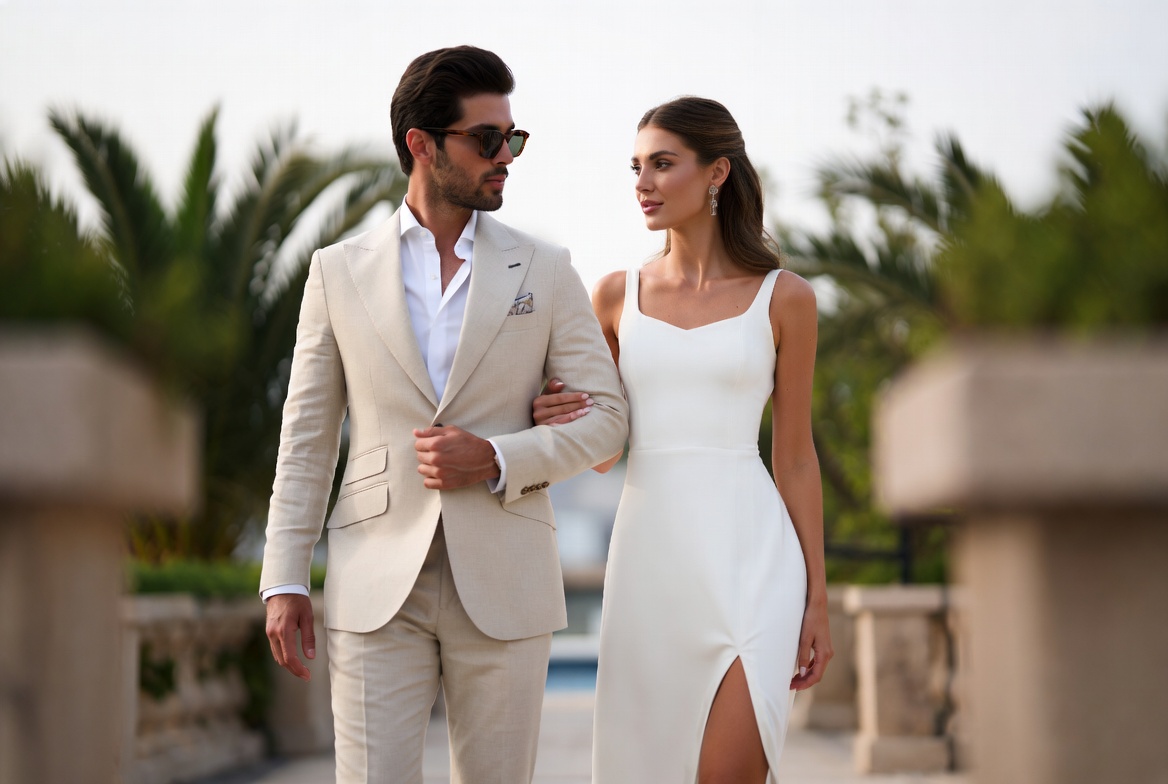
The style argument for quiet luxury travel dressing is familiar by now: unbranded, well cut, quietly expensive. Less discussed is that the fabric this look leans on hardest, merino wool, is also the one that happens to solve the real mechanical problems of travel: creasing, odor, and weather that won’t stay put.
Fold a good merino piece and it barely remembers the crease. That’s the fiber’s natural crimp at work, a springy coil that resists the flattening other fabrics succumb to, letting a garment shake itself back into shape after hours folded in a case. The same fiber is hygroscopic, taking on close to a third of its weight in moisture without ever feeling wet, and it works in both directions on temperature, warm when it’s cold out, breathable when it isn’t. And because its lanolin-coated structure resists the bacteria that cause odor, a merino piece can go several days between washes without announcing itself.
None of that is why Loro Piana, Brunello Cucinelli, and The Row built their names on fine wool and cashmere. That came from feel and drape, full stop. But it’s a useful coincidence that the fabrics quiet luxury has always prized for their hand are the same ones performance-travel brands spent the last decade reverse-engineering for entirely functional reasons. One fiber, two audiences, two very different reasons to care.
Building the framework
There’s a specific order to building a capsule that actually earns its keep, and most that fail to deliver skipped a step somewhere.
Start with the palette, not the pieces. Every item has to work with every other item, so color gets decided before anything else. A tonal neutral base, camel, oat, charcoal, navy, ink, the colors of raw wool and wet stone, with one accent carried through two or three pieces, gives the broadest possible combination range without tipping into flat or monastic. Introduce a second, unrelated color family, a green next to a burgundy, and the number of usable outfits roughly halves, because now only some of the pieces are on speaking terms.
Layer by function, not by garment type. Instead of shopping in categories, shirts, sweaters, coats, think in three functional layers: next-to-skin (the merino or fine cotton base handling moisture), mid (structure and warmth, a substantial knit or shirt), and outer (weather and polish, something that can go from car door to restaurant table without a change of clothes). The mid layer tends to carry the most weight in a well-built capsule, since it does the most combinatorial work.
Let footwear set the ceiling, not the floor. Shoes are usually the heaviest, least packable items in any case, so decide the count first and build everything else to fit around it, rather than tacking shoes on at the end. Two pairs, one built to walk for hours and still pass for smart-casual, one that elevates for evening, cover almost every quiet luxury itinerary. A third pair earns its place only for a genuinely different use case: hiking, beach, black tie.
One structural outer piece outperforms three casual ones. A well-cut coat in a dense, substantial neutral wool, heavy enough to hold its own shape rather than collapse against the body, makes almost anything underneath it read as intentional. That’s why outerwear anchors a quiet luxury look rather than finishing it as an afterthought, and it tends to be the single most photographed, most repeated piece in the case.
Accessories are where the discipline is hardest to hold. A structured leather bag, one fine belt, a single set of understated jewelry, this is the category most tempted by “just one more,” and it’s where quiet luxury dressing most visibly parts ways with louder alternatives. The rule that actually holds: an accessory earns its spot only if it works with at least three outfits already planned, never because it’s beautiful sitting on its own.
Where the philosophy has real limits
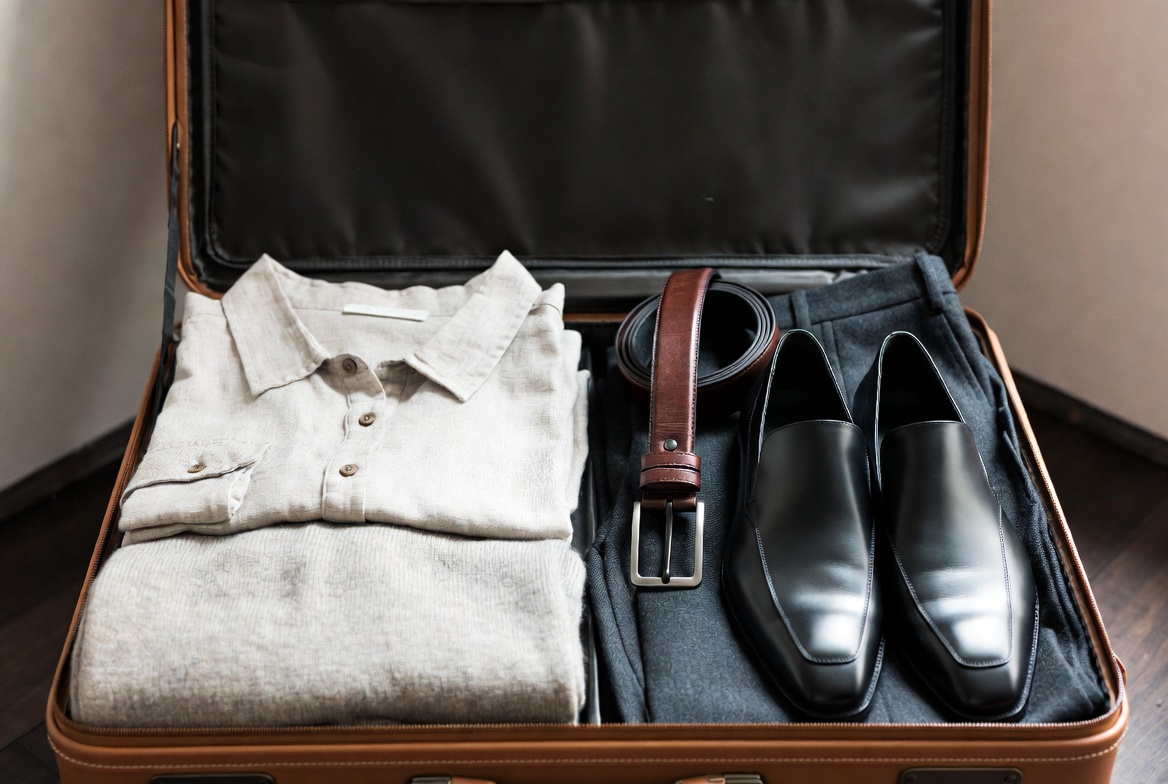
The aesthetic deserves the same candor applied to everything else here, and a capsule isn’t the right call for every traveler or every trip.
- It costs more going in, not less. Genuinely well-made merino, cashmere, and fine cotton pieces cost more than a suitcase of fast fashion, even where the per-wear cost ends up lower over time.
- It assumes a fairly narrow range of activities and climates. A trip running from formal city dinners to a multi-day trek needs two capsules, or a handful of single-purpose additions, not one tidy twelve-piece solution.
- It’s less expressive on purpose. A palette built for interchangeability is necessarily less exuberant than one built for color or pattern. A traveler who dresses as a form of self-expression rather than restraint may find the whole approach working against the reason they enjoy getting dressed in the first place.
It’s also fair to say plainly that “quiet luxury” has been thoroughly commercialized since it entered everyday vocabulary, to the point that much of what’s sold under the name is beige fast fashion with the branding sanded off, not the construction the aesthetic originally stood for. The tell is in the hand of the fabric and the finishing, a hem, a seam, a button, never in the color story, which is easy to copy and reveals almost nothing on its own.
What actually signals quality in the case
Because the aesthetic strips out the usual visible markers, no logo, no obvious branding, quality has to show up somewhere else: in details that reward touch and close attention rather than a glance from across the room.
- Full or half-canvas construction in tailored pieces, rather than fused interlining, which shapes how a jacket drapes and ages, not just how it looks on day one.
- Horn or corozo buttons, with a bit of natural weight and grain to them, rather than plastic.
- French or bound seams on the inside, the part no one else will ever see, which is exactly the point.
- Natural fiber content stated plainly, rather than buried behind a blend that’s mostly synthetic filler.
Elizabeth Currid-Halkett’s work on “inconspicuous consumption” gets at the underlying logic well: spending has drifted toward markers invisible to strangers but instantly legible to anyone who knows how to look, the fall of a fabric, the way a collar sits, a lining no one but the wearer will ever feel.
Which is the real case for building a capsule instead of packing a suitcase full of unrelated outfits. It was never really about minimalism as a virtue, or about hiding what something cost. It’s that the constraints themselves, one palette, fabrics chosen for how they perform as much as how they look, a fixed and disciplined number of pieces, are what push the quality out where it can be seen. There’s nowhere else left for the eye to go.







Leave A Comment