

The city never built the palace hotels of Paris or Vienna. What stands instead, a post office, a music academy, a merchant’s warehouse, each rebuilt as a design-led residence, makes a stronger case for quiet luxury than any marble lobby.
In January, the rooftop pool at Villa Copenhagen holds around 35 degrees. The air above sits below freezing. Locals swim laps in the steam and look out over Tivoli. Three floors down, the building spent a century sorting the nation’s post. Surplus heat from the structure warms the water. Nothing on site announces any of this. You have to be told.
That reticence runs through Copenhagen’s best hotels. Name it directly, because the city’s reputation misleads. Danish design means restraint, so visitors expect Copenhagen to overflow with quiet luxury addresses. The reality is narrower and more interesting. For years the city held little luxury stock in the conventional sense. No roster of marble palaces. Few grande dame hotels. What emerged over the past decade is a category Copenhagen half-invented for itself: the design house. Civic and industrial buildings, stripped back and rebuilt as places to sleep, where luxury lives in materials, proportion and the feel of a private residence rather than in spectacle.
Luxury grafted onto utilitarian bones
Look at what these buildings used to be.
- Villa Copenhagen occupies the Central Post and Telegraph headquarters, finished in 1912. Heinrich Wenck designed both the post building and Copenhagen Central Station next door.
- Nobis sits in the former Royal Danish Academy of Music, a 1903 building of high ceilings and good plaster.
- Audo House was a merchant’s residence and trading company headquarters from 1918, one of the oldest structures in Nordhavn.
- Hotel Sanders began as an 1869 building, later a run-down three-star, gutted to the walls before its rebuild.
- Park Lane inhabits a heritage building in Hellerup with a past life as a cinema and a ballroom.
The pattern matters. Taking a post office or a music school, preserving the façade and the civic dignity, then grafting comfort onto the shell without erasing the original purpose, is a quiet gesture by design. Compare an expensive coat with no visible logo. The economist Elizabeth Currid-Halkett calls this register inconspicuous consumption: status expressed through knowledge and discernment rather than display. A traveller who sleeps inside a converted merchant’s house, surrounded by furniture whose designers they know by name, signals something different from a traveller who wants a chandelier. Copenhagen sells the first thing.
One honest complication. The word quiet does two separate jobs here, and these five houses pull them apart. Quiet as scale means intimacy, few rooms, the hush of a place barely operating as a hotel. Quiet as aesthetic means restraint, neutral palettes, no gilt. A property delivers one without the other. Choosing well starts with knowing which kind you want.
Hotel Sanders: restraint that runs warm
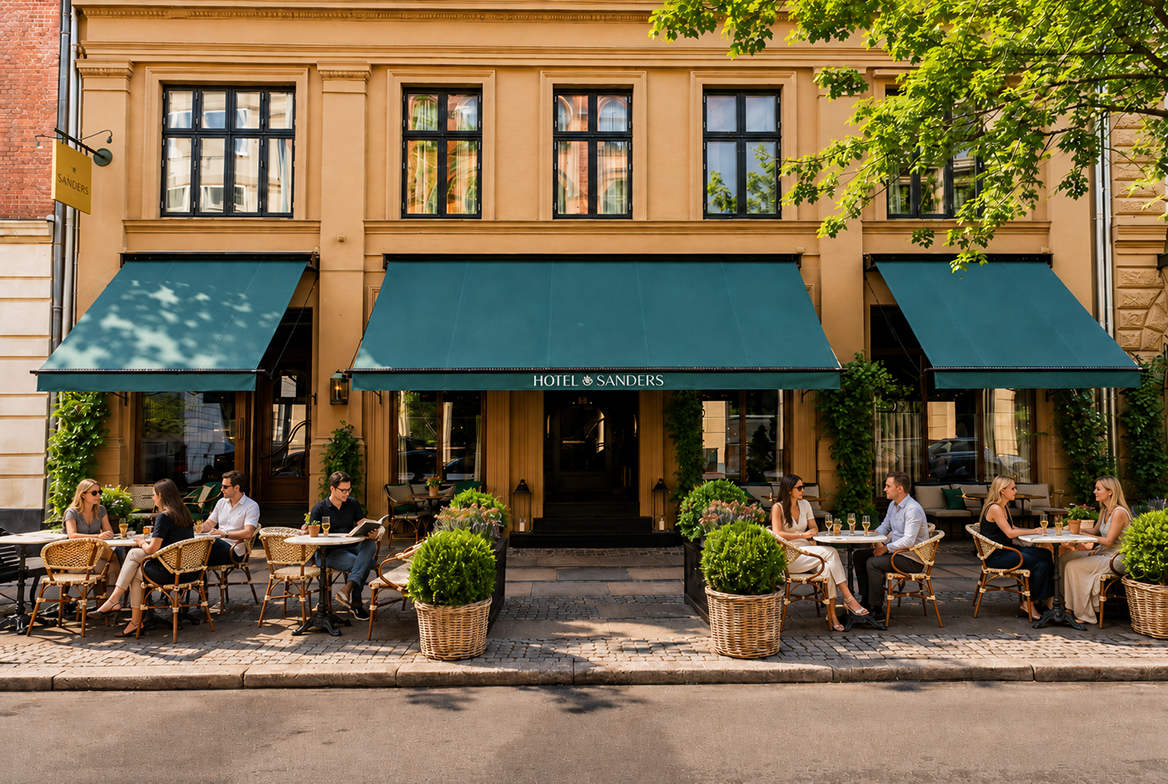
Hotel Sanders disproves the idea of Scandinavian luxury as pale and minimal. It earns first place for exactly that reason. The hotel sits on a side street behind the Nyhavn canal, a short walk from Kongens Nytorv and the Royal Danish Theatre. Alexander Kølpin, a former dancer with the Royal Danish Ballet, founded the property, and a choreographer’s instinct shows in how the public rooms stage entrance, pause, light and texture.
London studio Lind + Almond designed the interiors and moved deliberately away from cool Nordic minimalism. Expect cognac tones, rattan and bamboo, antiques, a planted courtyard and a rooftop garden. The result reads as the townhouse of a well-travelled friend with good taste and a theatrical streak. Guests praise the service for attentiveness without hovering, a difficult middle register to hold.
Square metres are the caveat. Entry-level rooms run genuinely small, with some atrium-facing doubles around 12 to 13 square metres. The hotel states this openly, which is part of the appeal, and should shape how you book. Sanders rewards guests who treat the whole house as their room: courtyard, Living Room lounge, rooftop, bar. Anyone who measures luxury in floor area should book a larger category or look elsewhere. The quiet here is atmospheric, not spatial.
Nobis: restraint as stated philosophy
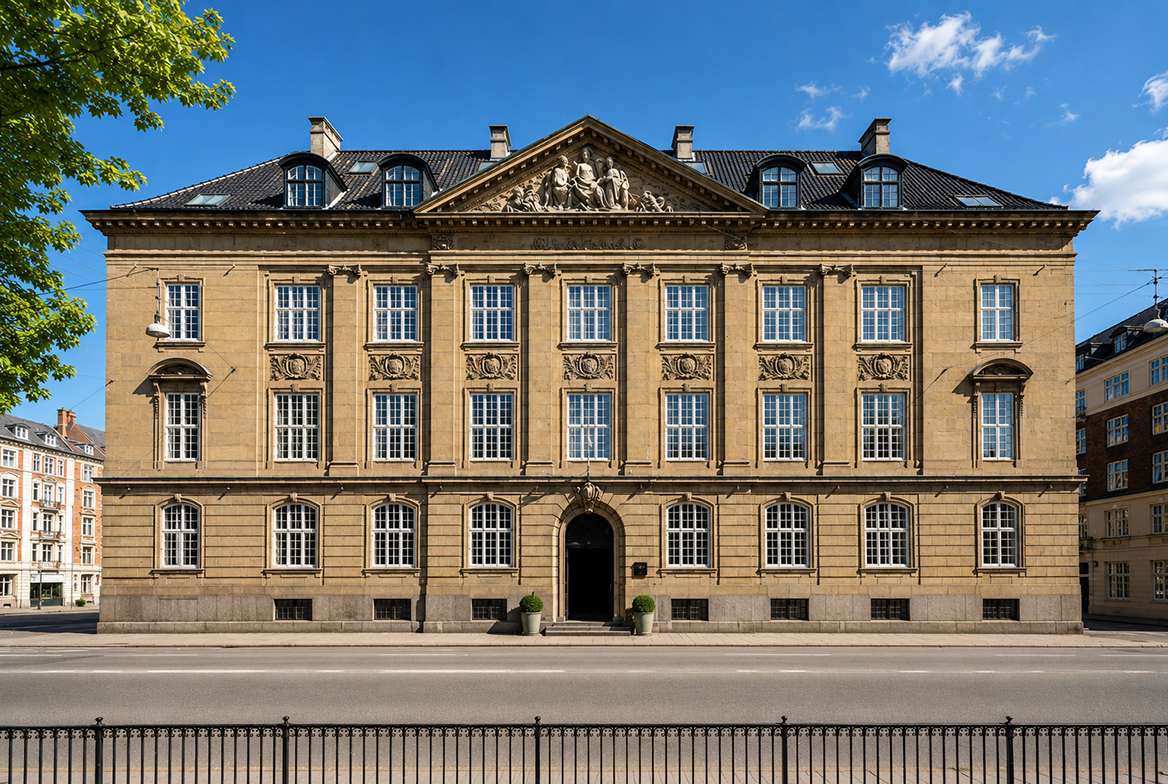
Sanders argues for warmth. Nobis argues for cool, composed serenity, and argues on principle. The hotel belongs to the Swedish Nobis group, whose founder has described wanting elegance and efficiency stripped of the unnecessary excess and artificial service traditional luxury piles on. The building delivers. High ceilings survive from the old music academy. Grey marble runs floor to ceiling in the bathrooms. Architect Gert Wingårdh designed an interior built on timelessness rather than trend.
Wellness separates Nobis from the group. A marble relaxation area in the lower level runs the Nordic hot and cold circuit properly, with sauna, hammam hot stone and cold plunge, plus a fitness room. Guests often report having the space to themselves. The location suits the argument: steps from Tivoli, the Glyptotek and Central Station, central without frenzy. Reviewers return to the same two words. Quiet. Attentive.
Some rooms run smaller than the photography suggests, and storage stays tight. This footnote applies across the city’s design stock rather than to Nobis alone. Set expectations accordingly. You pay for design, materials and calm, not for floor space.
Audo House: the purest intimacy
For quiet in the strictest sense, a place barely registering as a hotel, Audo House stands as the clearest example in the city. Ten rooms, all on the top floor, tucked under the rafters of the 1918 merchant’s house in Nordhavn. The rest of the building runs as a hybrid: café, restaurant, concept store, library, workspace and showroom for the Danish design brand Audo Copenhagen, whose furniture fills every room. The name comes from the Latin ab uno disce omnes, meaning “from one, learn all.”
Norm Architects led the conversion with the brand and former Kinfolk editor Nathan Williams. One idea drives the whole scheme. The higher you climb, the warmer and more intimate the materials become. Concrete and brass downstairs give way to oak floors, chalky plaster walls, marble and dark stone in the bathrooms, and beds dressed in cult Danish linens. Staying here means sleeping inside a taste object, a residence you could rebuild from a catalogue. Your temperament decides whether this reads as the most appealing or the most self-conscious thing about the place.
The trade-offs are structural. No spa. No pool. No concierge machinery. The offer is a beautifully made room and a community-minded house you are invited to treat as your own. Nordhavn is a converted port district, sleek and increasingly desirable, though a remove from the historic centre and a short metro ride away. Design pilgrims and solo travellers wanting stillness will find little better. Anyone wanting the apparatus of a full-service hotel will feel the gap.
Park Lane: space as the luxury
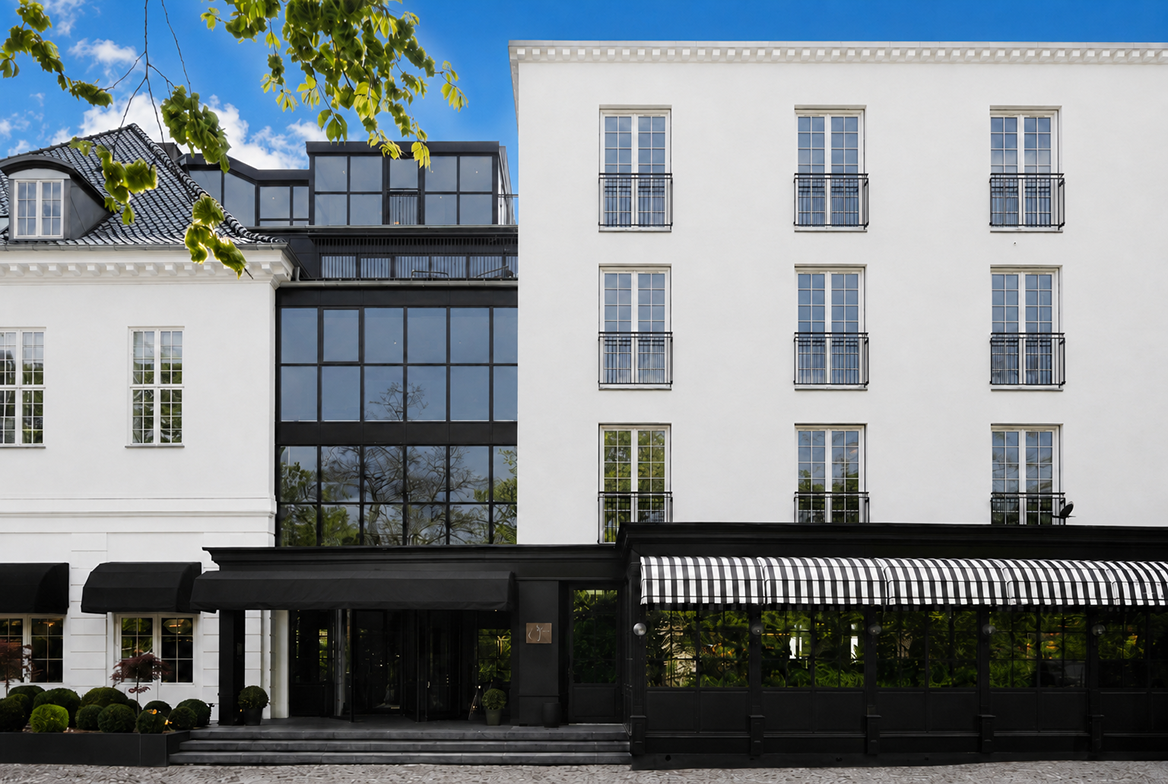
Park Lane stakes everything on the spatial kind of quiet and on the oldest luxury of all, room to breathe. The hotel sits outside the city in Hellerup, a moneyed northern suburb of villas and embassies, directly across from Øregård Park and minutes from the sea. Danish designer Camilla van den Tempel reworked the historic building into 69 rooms and suites in an all-white residential palette. Several rooms have French balconies or park views. The property joined Small Luxury Hotels of the World on opening.
The proposition is straightforward. Trade a central address for tranquillity, daylight and generous space. Guests rate the calm and the setting highly. For travellers avoiding the busiest tourist quarters, or drawn to a green residential base with the centre 15 to 20 minutes away by bike or taxi, the trade works.
Two candid notes. First, this is a young hotel. It opened in early 2025, a spa concept remains in progress, and the dining lineup has shifted visibly since launch. Confirm what is actually open when you book rather than trusting any single listing. Second, distance cuts both ways. The location delivering the calm also commits you to journeys in and out. Some guests have felt the price runs ahead of the product, a fair point to weigh for a property still finding its feet. The space is real. The maturity is arriving.
Villa Copenhagen: calm design, social house
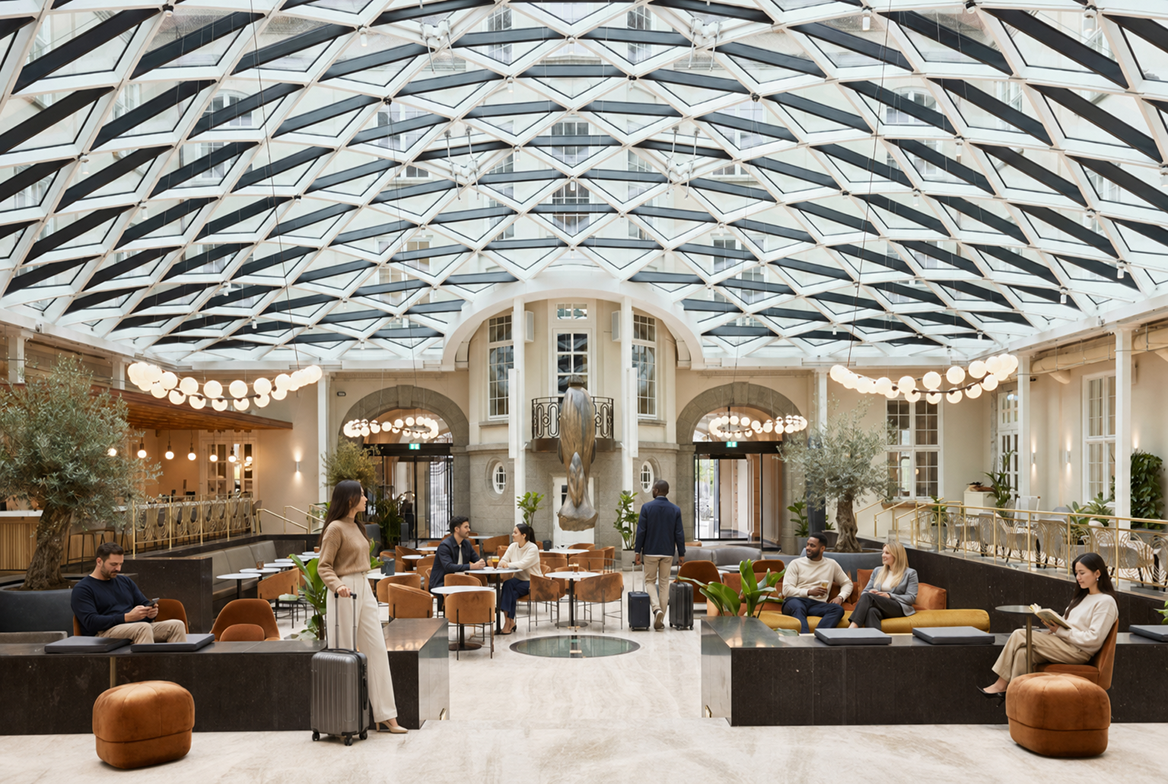
Villa earns its place by complicating the premise, which is the most useful work it does here. Visually the hotel reads as restrained and Scandinavian, with herringbone floors, neutral tones, Finn Juhl chairs and a serious art collection threaded through the public rooms. By that measure, unambiguous quiet luxury. Then count the rest. Villa holds 390 rooms, an atrium lobby bar working as one of the city’s evening hubs, a much-loved in-house bakery, a busy brasserie and the rooftop pool. In atmosphere, Villa is a grand social hotel. Not a hush.
Read this as a correction of expectations rather than a criticism. The conscious luxury framing holds up. Sustainability measures run through the fabric of the building rather than sitting in the marketing, from the surplus-heated pool to the absence of single-use plastics. For a certain traveller, the energy is the whole appeal. You want design, comfort and calm in your room, then life and noise and a strong breakfast the moment you step out of the door. The location beside Central Station and Tivoli suits that rhythm exactly.
If your definition of quiet luxury includes actual quiet, the absence of crowds and event, Villa is the one property here where the look and the feel diverge. Book for the design, the swim and the sociability. Do not book expecting a retreat.
Who each house is for
The five sort cleanly once you know which quiet you want.
- Sanders for atmosphere and a private-house feel in the dead centre of town, provided you embrace the scale.
- Nobis for composed, marble-calm serenity with a proper wellness circuit.
- Audo for the purest intimacy and a near-religious commitment to design, if you will do without full-service trappings and accept Nordhavn.
- Park Lane for space, daylight and distance from the crowds, accepting a suburban address and a young operation.
- Villa for restrained design wrapped around a large, lively, genuinely sociable hotel. Quiet to look at. Anything but quiet to inhabit.
A word on cost, kept loose because Copenhagen rates move sharply with season and demand. Entry-level doubles across this group tend to sit roughly between DKK 2,000 and 3,500 a night. Suites and peak dates climb well beyond. Treat any figure as directional. Book early for summer and the design-week weeks, when the city fills and the better rooms go first.
One thread unites all five, and the city stumbled into it. Copenhagen’s quiet luxury is not the quiet of a velvet-roped palace. This is the quiet of a building with a former life and too much good manners to mention it. A post office. A music school. A warehouse on the water. Each keeps its history close and offers you somewhere comfortable and discreet to sleep.




Leave A Comment